


EDITORIAL: Reports suggesting a de facto partition of Gaza between areas controlled by Israel and those under Hamas rule point to a grim turn in the region’s political and humanitarian trajectory. What was initially presented as a temporary security arrangement under the first phase of US President Donald Trump’s plan to end the war on Gaza now seems to be leading to a long-term division – one that entrenches Israeli dominance over much of the territory.
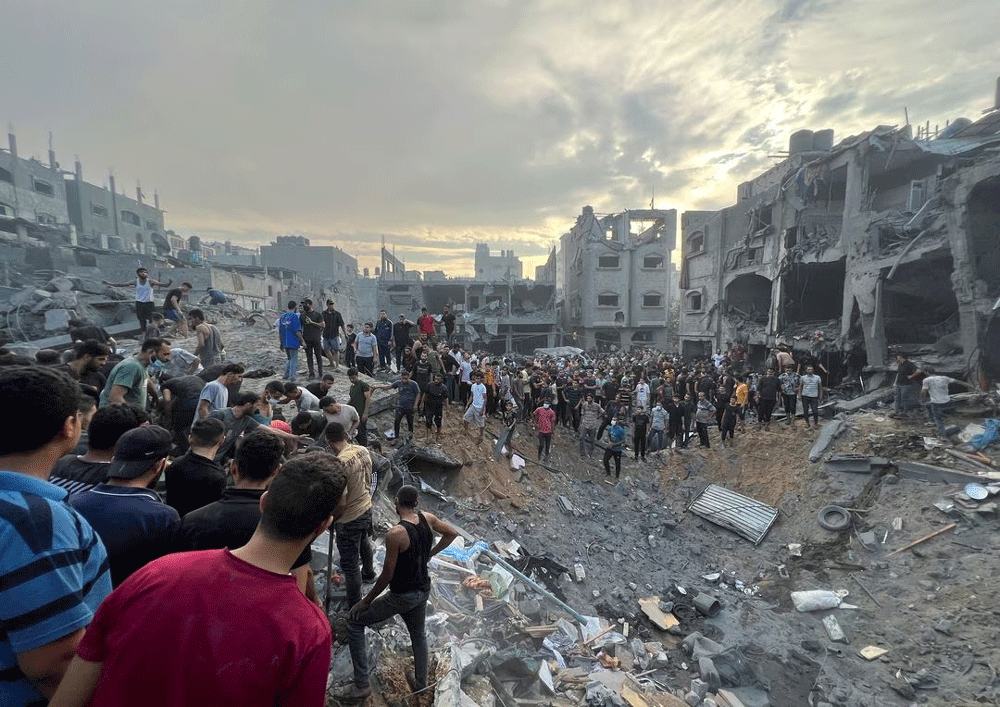
Under the first phase of the plan, which took effect on October 10, Israel occupies more than half of the Gaza Strip – about 53 percent of the Mediterranean enclave, including its most fertile farmland, the southern city of Rafah, and major portions of Gaza City. The remaining population, estimated at around two million people, is crowded into makeshift tent camps amid the toxic rubble left by two years of saturation bombing in areas still under Hamas control. These conditions have produced one of the world’s worst humanitarian crises and risk normalising the permanent displacement of Palestinians from their homes and farmlands.
The plan’s second phase envisages an Israeli withdrawal behind the so-called “yellow line” or initial withdrawal boundary, the creation of a transitional governing authority, deployment of an international stabilisation force (ISF), disarming of Hamas, and start of large-scale reconstruction. Yet the plan provides no clear timeline, enforcement mechanism or practical roadmap for achieving these goals. Meanwhile, Israel’s ongoing military presence and repeated violations of the ceasefire, widely seen as efforts to depopulate and fragmentise Gaza, directly contradict the plan’s stated objectives. The undoubted aim is to permanently redefine Gaza’s political landscape under the guise of security. Arab and Muslim-majority countries expected to contribute troops to the proposed ISF remain reluctant to join what they fear could be an unequal mission overseen by a US-led “Board of Peace.” Some, including Pakistan and Indonesia, have expressed willingness to participate in a UN-mandated stabilisation force, but not one perceived as a “B team” to Israel, focused primarily on disarming Hamas while legitimising continued Israeli control.
For its part, Hamas is ready to hand over Gaza’s administration to a Palestinian-led authority and pave the way for reconstruction. Israel’s actions, however, are intended to retain direct or indirect control over post-war Gaza, undermining the very notion of Palestinian self-determination. This tension exposes the central flaw in the Trump plan: it assumes progress can be imposed through military leverage rather than achieved through genuine political negotiation. The US bears responsibility for the implementation of the plan it brokered and continues to underwrite. Given Israel’s dependence on US military aid and arms shipments, Washington has the leverage to demand compliance.
If President Trump truly wishes to see his peace initiative succeed, he must use that leverage to ensure a full Israeli withdrawal from Gaza and the unhindered delivery of humanitarian assistance. Without that, the so-called peace plan risks becoming little more than a blueprint for partition and perpetual instability.
Copyright Business Recorder, 2025




















Comments
Comments are closed for this article.