


26th Amendment petitions: Justice Jamal questions bench formation amid calls for full court
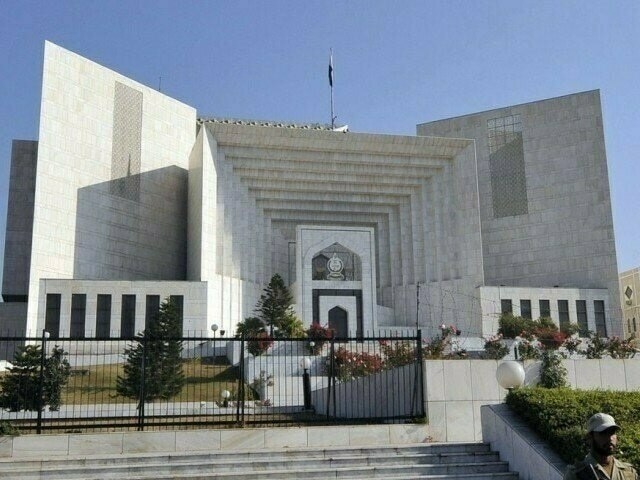

ISLAMABAD: Justice Jamal Khan Mandokhail questioned whether the benches are formed based on wishes or as per the law, as the petitioners’ demand to ignore Article 191A of the Constitution, but also ask the constitutional bench to order the constitution of a Full Court to hear the petitions against the 26th Amendment.
An eight-judge bench, headed by Justice Amin-ud-Din Khan, on Thursday heard the petitions filed by former Chief Justice of Pakistan Jawad S Khawaja, the Pakistan Tehreek-e-Insaf, the Jamaat-e-Islami, the Sunni Ittehad Council, chairperson of the Tehreek-i-Tahaffuz Ayeen-i-Pakistan Mustafa Nawaz Khokhar, and different bar councils and associations.
Uzair Bhandari, representing the Sunni Ittehad Council, called for constituting the full court to hear these petitions. Justice Jamal inquired who would constitute the Full Court, as it is not defined in the Constitution, but had been set up because of the precedents.
Bhandari said that the formation of the Full Court has been described in Article 176 of the Constitution, adding that the Committee’s 31st October decision is still intact, and it should be enforced.
The Committee, comprising Justice Syed Mansoor Ali Shah and Justice Munib Akhtar, on 31st in the chambers, passed an order that 26th Amendment petitions should be heard by the Full Court, and directed the Supreme Court’s Registrar to fix it before the Full Court. However, it was not complied with.
Bhandari asked the bench not to bog down with procedural technicalities. He argued that all 24 judges can hear petitions, and there is no legal bar, but it seems awkward that the judges, appointed as a consequence of the 26th Amendment, hear the case. The Full Court should decide for itself whether those should sit or not.
Upon that, Justice Jamal remarked that they were given additional responsibility in light of the 26th Amendment, adding that those judges were also inducted into the Supreme Court as a result of the 26th Amendment.
Justice Muhammad Ali Mazhar questioned whether the Committee, set up under the Supreme Court (Practice and Procedure) Act, 2023, was authorised to pass an order dated 31st October for the Full Court, and whether it was a valid order, and whether it is binding on a constitutional bench?
Bhandari contended that no one had filed any petition to suspend the Amendment. Had it been done then, the constitutional bench could not have heard this case, and also the Super Tax case. However, he stated that the moment judges (of this bench) feel they are bound by Article 191A, then what remains in challenge?
To that, Justice Mazhar asked, “Do you want this bench to ignore Article 191A?”, adding, “If we do so then there is no need for a constitutional bench, and a regular bench can hear the petitions.” He said the main issue before them is how the constitutional bench can ignore Article 191A. The judge further said that they were hearing this case because of clause 3 of Article 191A, as under this article, no bench other than the constitutional bench can hear constitutional matters. Justice Musarat Hilali said, “We are sitting as a constitutional bench,” and then questioned, “Do we have the power to constitute the Full Court?” She further asked whether the matter before this bench is of a constitutional nature? Justice Bilal Hasan said ignoring Article 191A at this stage means granting major relief to the petitioners in this case.
Bhandari contended that if the bench says Full Court cannot be constituted, then you are denying petitioners substantial relief. He stated that it (191A) is de facto valid, but its de jure validity is in question.
Justice Mazhar said for the first time, such a situation has emerged, which is a unique position. Justice Jamal questioned whether this bench or the Full Court has jurisdiction to hear the petitions.
Bhandari stated in his opinion that both – Full Court and the Constitutional Bench have jurisdiction. He pleaded that the validity of Article 191A needs to be decided first, adding that if the Court considers this article valid, then there are obstacles.
Justice Jamal noted that there is no definition of the Full Court and the benches erstwhile used to be formed under Supreme Court Rules, 1980, and every bench was competent to hear suo moto, but after the enactment of the Supreme Court (Practice and Procedure) Act, 2023, no bench less five-judges was eligible to hear suo moto, and now after the 26th Amendment only the constitutional bench can hear suo moto.
Justice Ayesha A. Malik said that Article 191A is not an ouster jurisdiction, but it is exercisable and is vested in the Supreme Court. She said Article 191A has not ousted the jurisdiction of the Supreme Court. However, question whether this bench under Article 191A is empowered to exercise this jurisdiction to form a Full Court. She remarked that Supreme Court jurisdiction has not been curtailed because of Article 191A. Bhandari argued that the SC Rules have vested the power in the Chief Justice of Pakistan to form a bench(es) or Full Court for hearing of cases under Article 184(3). However, now, due to Article 191A, the cases under 184(3) can only be heard by the constitutional bench.
Justice Mazhar stated that the members of the constitutional bench are also the judges of the Supreme Court, but here the question arises that if they pass an order that other judges, who are not members of the constitutional bench, could become part of the Full Court, then won’t they be violating the law?
Justice Naeem Akhtar Afghan said, when the petitioners say this bench has jurisdiction to hear the 26th Amendment, then why not trust it? Bhandari replied, “I trust this bench, but the problem is of propriety.” To that, Justice Afghan remarked, if you trust, then start arguments on the merit of the case.
At the outset, advocate Shahid Jamil Khan, appearing on behalf of Mustafa Nawaz Khokar, wanted to argue on his appeal filed against the SC Registrar’s objections. However, the bench said it will hear him at the end.
The case was adjourned until November 10.
Copyright Business Recorder, 2025

























Comments
Comments are closed for this article.