


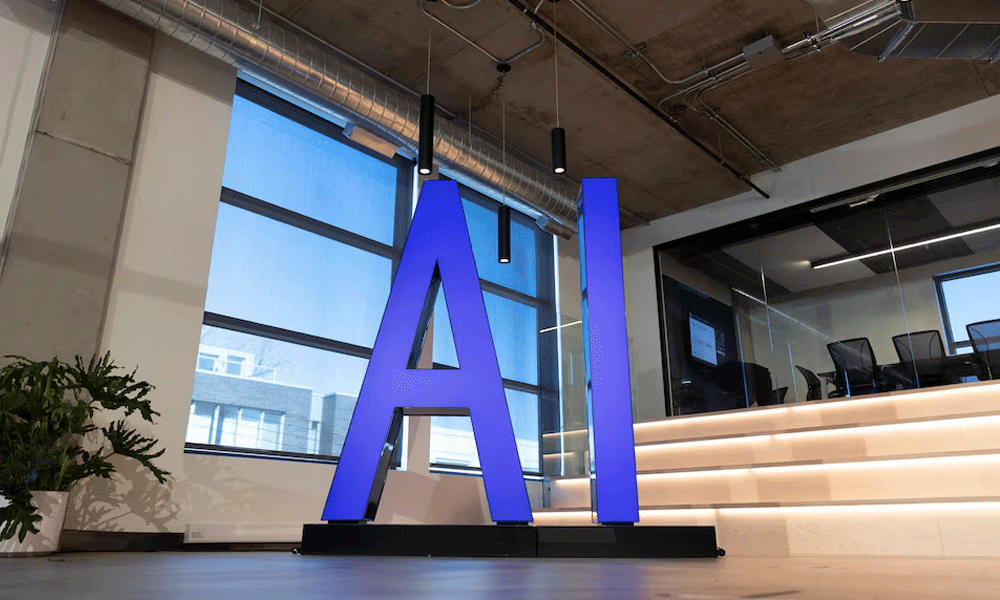
In the age of artificial intelligence, the greatest challenge for leaders is not to think like machines but to remain human.
As Artificial Intelligence reshapes global economies, leadership is being rewritten. Algorithms now guide decisions once rooted in human intuition, from recruitment and performance reviews to business strategy and policy design. The question is no longer whether AI will replace leaders but how humans will continue to lead effectively alongside machines.
According to Microsoft’s 2024 Work Trend Index, 79 percent of business leaders worldwide believe that their organizations must adopt AI to remain competitive. However, 60 percent admitted that they lacked a clear strategy for doing so.
Meanwhile, 75 percent of knowledge workers now use AI at work, and almost 70 percent of early adopters of Microsoft Copilot report feeling more productive, completing tasks nearly 30 percent faster. Still, almost half of employees globally fear that AI might replace their jobs.
This paradox captures the central tension of our era: people are excited by AI’s potential, yet they still crave human connection, empathy, and trust from those who lead them.
AI does not just automate work; it augments human capability. Leaders now rely on predictive analytics to forecast trends, chatbots to handle employee queries, and data-driven tools to make strategic decisions. However, as AI takes over routine tasks, it also tests the emotional and ethical dimensions of leadership. Machines can process patterns and probabilities, but they cannot understand emotions or inspire purpose. The future of leadership will not belong to those who master technology but to those who humanize it.
In today’s hybrid and digitally-mediated workplaces, emotional intelligence has become a strategic asset. As technology increasingly filters communication, leaders must bridge the human gap by interpreting not just data, but the emotions and values behind it. When AI tools are introduced without sensitivity, they risk isolating teams. But when deployed to promote transparency, fairness, and inclusion, they enhance trust and performance.
For Pakistan, these dynamics carry urgent significance. The country is on the verge of a digital transformation, but leadership mindsets often remain anchored in outdated hierarchies. Across the public and private sectors, digital initiatives are still treated as IT upgrades rather than opportunities for cultural and strategic renewal. This limits Pakistan’s ability to fully leverage AI for competitive innovation.
To move forward, Pakistan must invest as much in its people as in technology. Leadership development should not end at technical training; it must integrate digital ethics, data governance, and human-centered AI strategy. The next generation of Pakistani leaders must combine analytical precision with emotional intelligence and use data responsibly while maintaining public trust.
Creating this shift will require a national commitment. Workshops, policy dialogues, and leadership conferences that bring together global experts, educators, and industry professionals can serve as learning laboratories. These forums should not only explore how to implement AI, but also how to govern it ethically, how to balance efficiency with empathy, and innovation with inclusion.
Pakistan’s universities, training institutes, and professional schools play a vital role. Education at every level must evolve from teaching digital skills to cultivating a digital consciousness. Future leaders whether in business, academia, or public service should be equipped not only to ask, “Can we use this technology?” but also, “Should we, and how?” Building such reflective capacity is essential to ensure that Pakistan’s digital transition strengthens social cohesion, institutional trust, and ethical governance rather than fragmenting them.
Ultimately, Pakistan’s journey toward an AI-driven digital economy will depend as much on human leadership as on technological progress. Machines may optimize performance, but they cannot inspire purposes. As AI assumes repetitive work, leaders must focus on creativity, collaboration, and compassion, the distinctly human dimensions that define lasting success.
The future of leadership will not be written in codes. It will be written by those who best understand humanity. In Pakistan’s digital age, wisdom, empathy, and integrity, not algorithms, will define great leadership.
Pakistan’s digital future will not only be built by smarter machines but also by wiser, more human leaders.
Copyright Business Recorder, 2025
The writer is an Assistant Professor at the Pakistan Institute of Development Economics (PIDE). She can be reached via Email at: [email protected]

















Comments
Comments are closed for this article.