


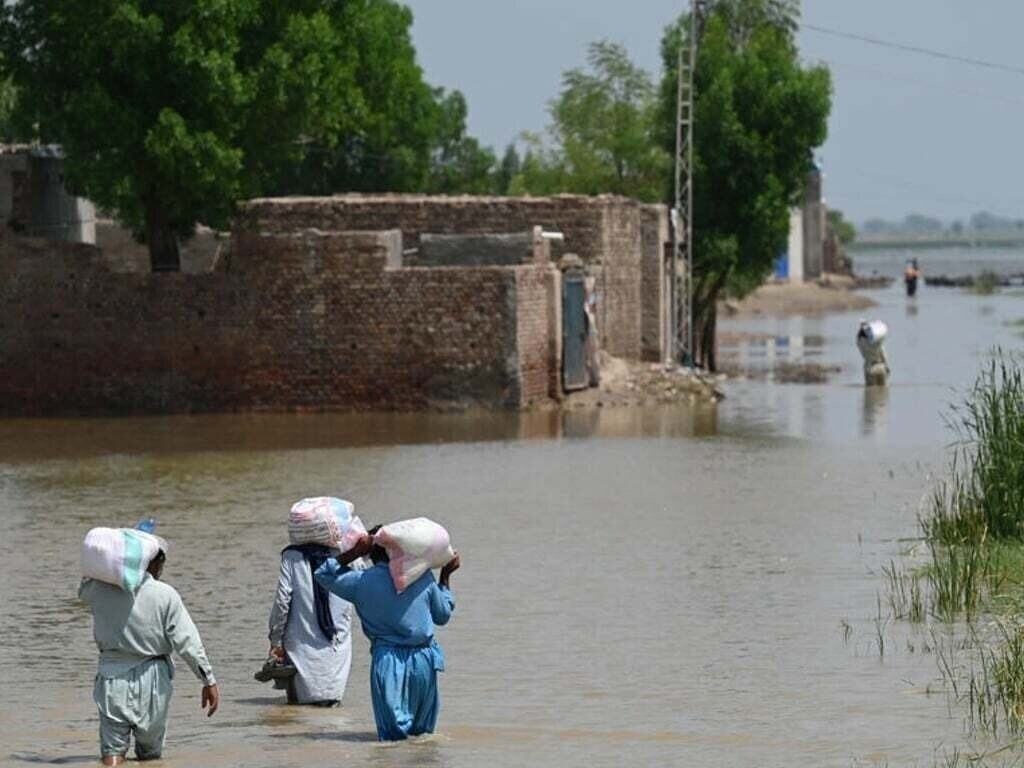

Pakistan, a nation that contributes less than one percent of global greenhouse gas (GHG) emissions, paradoxically ranks among the top-most climate-affected countries globally. The climate emergency is no longer a distant threat; it is an economic and social reality that is aggressively challenging our national solvency, development ambitions, and the very fabric of our society.
For the country’s business and finance sector, this crisis demands a radical shift from viewing climate action as a mere Corporate Social Responsibility (CSR) activity to recognizing it as a core pillar of economic and financial stability. The central tenet of this required transition must be the principle: leave no one behind.
The devastating 2025 floods served as a catastrophic warning; over 6 million people were affected, with more than 1,000 lives lost across provinces. In Punjab alone, flood waters have submerged 2.2 million hectares of farmland, impacting over 5.1 million residents, as reported by the National Disaster Management Authority (NDMA).
In recent times, the nation has grappled with fresh spells of floods and extreme heatwaves, underscoring a frightening new normal. These are not just humanitarian crises; they are fiscal disasters. Climate-related events, environmental degradation, and air pollution are projected to reduce Pakistan’s GDP by at least 18 to 20 percent by 2050, as per World Bank estimates. For the finance sector, this erosion of the GDP represents an unacceptable level of risk.
The vicious cycle: climate shocks, poverty, and financial exclusion
The true scale of the climate crisis in Pakistan is measured not only in macro-economic losses but in the devastating impact on its most vulnerable citizens. When a major flood hits, it is the smallholder farmer, the non-formal sector worker, women, children, and the residents of villages that bear the disproportionate brunt.
The agricultural sector, which is the country’s largest employer, is acutely exposed. Yields are projected to drop by another 50 percent by 2050 due to land degradation and water-stressed conditions. When crops fail, the resulting food insecurity drives food inflation fears, directly impacting consumer purchasing power and macroeconomic stability.
The ‘leave no one behind’ principle, in this context, translates to de-risking the lives of the poor and the economy’s primary supply chains.
Financial inclusion as climate resilience: the current climate finance architecture, both domestic and international, is failing to reach the last mile. Climate finance flows into Pakistan are underwhelming, with domestic investment in green projects remaining negligible. Out of the estimated USD 30-USD 40 billion needed annually to meet our modest climate goals, our own private sector accounted for less than 5% of the climate finance flows in 2021. This is the institutional gap that leaves the vulnerable exposed.
We must pivot our finance models to anticipatory social protection. Federal and provincial governments, in collaboration with the private insurance industry, must develop disaster insurance programmes tailored for specific regional vulnerabilities. This includes subsidized crop insurance for small farmers and micro-insurance products for climate-displaced populations.
Mobilizing private capital for adaptation, basically, the State Bank of Pakistan (SBP) has a critical role in incentivizing commercial banks to price environmental risks and structure financing mechanisms like concessional loans and guarantees for climate-resilient construction, regenerative agriculture, and clean energy for the rural economy. Without a national framework and a carbon registry, Pakistan is also missing out on the fast-moving global carbon market, an opportunity to raise capital that could be funneled directly to grassroots resilience projects.
The business case for inclusive climate action
For the large-scale industrial and corporate sector, ignoring the climate emergency is no longer economically viable. Unchecked corporate activities, from industrial emissions to the over-exploitation of natural resources, contribute to the very environmental degradation that ultimately threatens business continuity.
The call for the private sector is clear: Environmental, Social, and Governance (ESG) must become the cost of doing business, not a mere marketing tool.
Supply chain resilience: Businesses relying on agricultural raw materials will face continuous supply chain shocks, pushing up input costs and sabotaging market stability. Investment in climate-resilient farming practices and water management systems, such as micro-irrigation and drought-tolerant crops, is an investment in future profitability.
Infrastructure investment: Instead of waiting for the next catastrophe to necessitate a reconstruction of infrastructure at monumental cost, the private sector should collaborate with the government to enforce new, climate-resilient construction standards for both public and private projects. This has immense long-term savings.
A just energy transition: The energy sector is a major drain on public finances. Accelerating a just transition to sustainable energy and low-carbon transport, as envisioned in the government’s National Clean Air Policy (NCAP) 2023, is essential. Incentivizing the Electric Vehicle (EV) industry and moving towards renewable energy, like the 10,000-megawatt solar project, will improve energy security and reduce the chronic fiscal stress linked to fossil fuel use.
A call for climate democracy and financial commitment
The declaration of a climate and agricultural emergency provides a political mandate to enact fundamental reforms. This is the moment to combine immediate relief with long-term sustained investments in climate adaptation and mitigation.
The path to leaving no one behind requires a ‘Climate Democracy,’ a framework that draws from constitutional climate rights and ensures that action is decentralized, reaching the most vulnerable. This means empowering local governments with authority for land-use planning and ensuring climate projects are pro-poor and gender-sensitive.
Pakistan has a massive climate investment gap of over USD 340 billion by 2030. To close this gap and protect its most vulnerable citizens, the nation needs political commitment that transcends election cycles, institutional agility to deploy capital, and a unified front from all stakeholders.
For the business and finance community, the choice is stark: either internalize the cost of climate vulnerability today through responsible, inclusive investment, or face the irrelevance of a climate-altered tomorrow. The financial future of Pakistan depends on how quickly we move beyond rhetoric to build a truly resilient, equitable, and inclusive nation.
Copyright Business Recorder, 2025
The writer is affiliated with the School of Management, Jiangsu University, P.R. China, and the Department of Agribusiness and Entrepreneurship Development, MNS-University of Agriculture, Multan, Pakistan. Connect with him on LinkedIn: linkedin.com/in/mananaslam
The writer is an independent researcher. He have authored multiple articles on agricultural economics, ICTs adoption, climate-resilient agriculture & agribusiness in leading dailies and SCI/SSCI/Scoupus indexed journals




















Comments
Comments are closed for this article.