


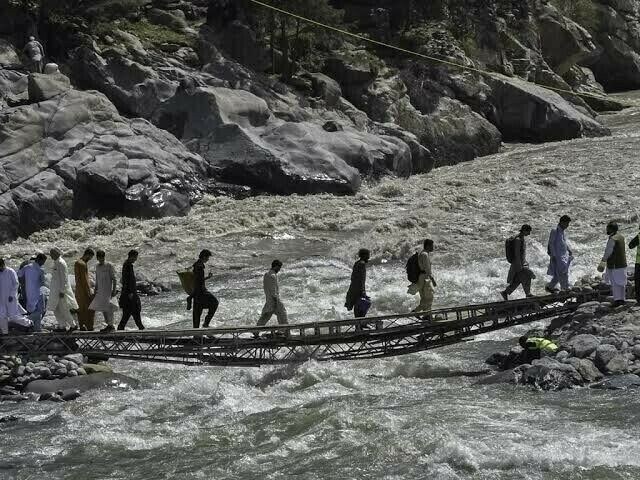

ISLAMABAD: The National Disaster Management Authority (NDMA) has forecasted that the ninth spell of the monsoon is likely to persist for the next two days, likely to bring more heavy rainfalls across the country, especially in the upper areas, over the next 24 to 48 hours.
According to the NDMA, rainfall is also anticipated in the southern parts of the country, including South Punjab and South Sindh, from September 6. The coastal districts of Badin, Sujawal, and Tharparkar are expected to receive heavy downpours.
The authority further warned that torrents from the Ravi, Chenab, and Sutlej rivers are expected to converge at Panjnad, raising the risk of severe flooding in the area from September 4 to 5. The authority further forecasted a low-pressure system entering Pakistan from India around September 6, bringing heavy rain and thunderstorms in Sindh, which is likely to continue till September 10.
“We are expecting rain in Tharparkar, Sajawal, Thatta, Badin, and Mirpurkhas from September 6-10,” the authority said, and added that Sindh is expected to receive torrential rain and thunderstorms during the period.
Meanwhile, the emergency response agency stated that approximately 5,700 tons of relief goods have so far been distributed among flood-affected communities across the country.
Moreover, the authority in an official communique issued here on Wednesday said that India alerted Pakistan over a new surge in the rivers of Sutlej and Tawi owing to the opening of spillways of barrages and dams.
Authorities have warned that a large volume of water is likely to flow into the rivers of Sutlej and Tawi, and water levels continue to rise dangerously, putting lives and property at risk. The NDMA said that India released more water into the Sutlej and Chenab rivers without using the Indus Water Commission’s official channel, instead informing Pakistan through diplomatic means.
The floodwaters of the Sutlej River have surged in southern Punjab, submerging dozens of low-lying villages, damaging crops, and forcing thousands of residents to relocate to camps.
Most parts of the country are reeling under the impact of relentless monsoon rains, which caused flash flooding, landslides, and water logging, and are still wreaking havoc across Punjab, Khyber Pakhtunkhwa (KP), and Azad Jammu and Kashmir (AJK).
According to the authority, the water levels in key rivers and headworks have surged significantly due to ongoing rainfall, raising the threat of flooding in low-lying areas. At Marala Headworks on the Chenab River, the water flow has reached 468,000 cusecs. Khanki Headworks is recording a flow of 339,470 cusecs, while Qadirabad Headworks stands at 232,450 cusecs.
At Trimmu, the water level is reported at 355,744 cusecs, and Panjnad Headworks is seeing 182,107 cusecs. The Chenab River at Chiniot Bridge has reached 108,343 cusecs. The Sidhani Headworks shows 193,470 cusecs, and the Islam Headworks records 95,727 cusecs, said PDMA.
The Sutlej River is also swelling, with Ganda Singh Wala recording 269,501 cusecs and Suleimanki Headworks reporting 122,736 cusecs.
The NDMA has urged citizens to remain cautious and follow instructions from local authorities, particularly in areas near rivers and canals.
According to NDMA data, this year the flash floods triggered by monsoon rains, and as a result, at least 883 people have been killed and 1,177 have been injured. The floods damaged 9,261 houses and killed at least 6,180 livestock. Of 9,261 damaged houses, 2,153 have been fully destroyed and 7,108 partially damaged.
KP remained the worst hit province as out of 883 deaths, KP reported 488, followed by Punjab with 223, Sindh 58, Gilgit-Baltistan (G-B) 42, AJK 37, Balochistan 26, and Islamabad Capital Territory (ICT) with eight deaths.
Copyright Business Recorder, 2025




















Comments
Comments are closed for this article.