


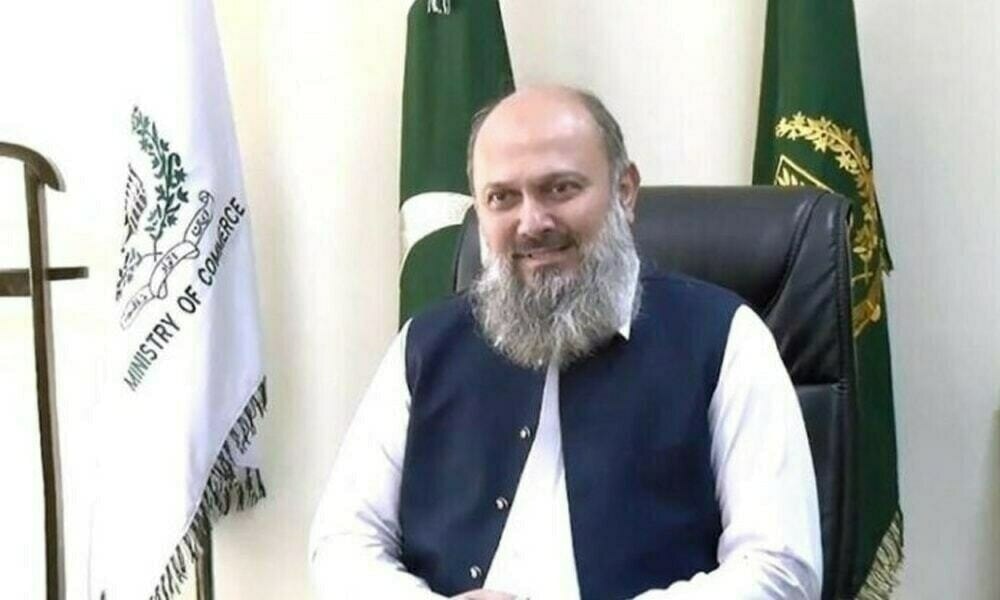

ISLAMABAD: Federal Minister for Commerce Jam Kamal on Friday informed the Senate that the government has approved sweeping import tariff reductions on around 300 products, aiming to spur industrial growth, cut consumer costs, and boost export competitiveness.
Responding to a calling attention notice in the House, the minister said the government had authorised tariff reductions on nearly 300 items – primarily goods not produced or readily available in Pakistan – while duties on 900 other products would remain unchanged under the National Tariff Policy.
Some import tariffs, he noted, previously reached as high as 40 per cent. The revised structure is designed to facilitate access to imported inputs used in value-added production and to lower costs for general consumers.
Pakistan reveals National Tariff Policy draft, aims to eliminate RDs, ACDs in 5 years
The reductions will be rolled out gradually, with some taking effect within a year, and others phased in over the next two to five years – an approach Kamal said would give local industries time to adapt.
“Tariff rationalisation has been undertaken for the first time,” he said, crediting Prime Minister Shehbaz Sharif and the federal cabinet for backing the reforms.
The goal, he added, is to strike a balance between supporting local industry and encouraging trade by removing unnecessary barriers.
The changes are part of a broader reorientation of Pakistan’s trade and economic policy. Kamal revealed that governance reforms had been introduced at the Trade Development Authority of Pakistan (TDAP) and the Export Development Fund (EDF), including the appointment of technical teams and consultants to evaluate funding requests – an effort to bring greater transparency and scrutiny to EDF’s Rs30 billion in pending approvals.
“In the past, large sums were approved without technical evaluation,” Kamal said. “That’s no longer the case.”
Several key positions in the Ministry of Commerce, including the head of research and head of compliance, have also been filled after years of vacancy.
The government, he added, is now working with renewed institutional capacity to implement trade agreements and frameworks with countries including the United Kingdom, Vietnam, Cambodia, and South Korea.
Further visits to the European Union, Geneva, and Brussels are planned to advance negotiations on the Generalised Scheme of Preferences Plus (GSP+) and other trade initiatives, he added.
He said that a new strategic plan for the National Export Development Board (NEDB), including sector-specific issues and timelines, has been completed and will be presented to the prime minister at the board’s next meeting.
The NEDB, he added, chaired by the prime minister, includes cabinet members and private sector representatives, and has expanded its sectoral councils from 13 to 19 – covering areas such as garments, leather, pharmaceuticals, surgical instruments, ICT, logistics, and tourism.
Kamal also acknowledged past practices that favoured certain industries while neglecting medium-sized enterprises, calling previous tariff regimes “arbitrary” and “counterproductive.”
Copyright Business Recorder, 2025


















Comments
Comments are closed for this article.