



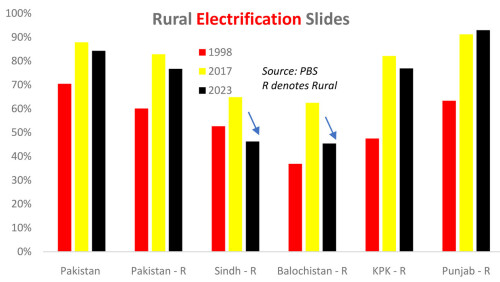
Pakistan’s latest housing census, conducted in March 2023, reported that 84 percent of households had access to grid electricity, down from 88 percent in 2017. While urban electrification remained broadly stable — slipping marginally from 97 to 95 percent — the rural story is where the real shift lies.
Rural grid access fell from 82 to 77 percent. At first glance, it may appear as a failure in infrastructure delivery. But a closer look at the data points to something else: Pakistan’s rural households are increasingly going off-grid by choice.
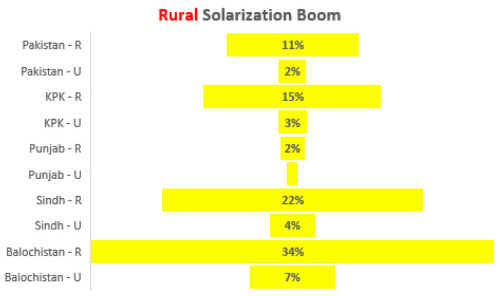
For the first time, solar appears in the national census as a significant category for household lighting — with 8 percent of households nationally and 11 percent in rural areas using solar as their primary source. In rural Balochistan and Sindh, that figure rises to a remarkable 34 and 22 percent, respectively. Punjab and urban Pakistan lags.
This transformation is not anecdotal. It is market-driven, organic, and bottom-up. The story unfolding is one of necessity-driven innovation — where communities have stopped waiting for the grid and have instead leapfrogged to decentralized, solar-powered setups.
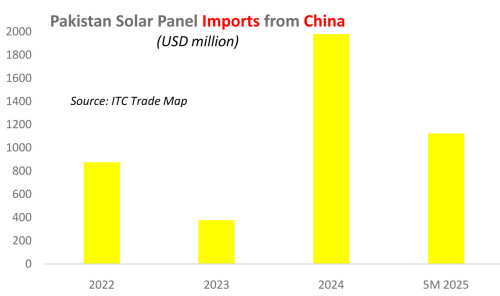
And the census only captures the beginning. Since March 2023, solar imports have surged. In all of 2023, Pakistan imported $377 million worth of solar panels. In the 17 months since, that number has jumped to $3.1 billion, including $1.1 billion in just the first five months of 2025.
Pakistan has imported more panels in the last two years than in all prior years combined. Add to that falling battery prices and the rise of DC-powered appliances, and a doubling of rural solar adoption post-census appears not just likely, but conservative.
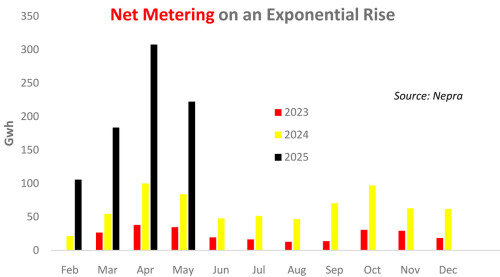
Meanwhile, the urban solar transition has taken shape in the form of grid-connected net metering systems — a phenomenon largely limited to high-income households. Here, too, the numbers are accelerating. Nepra data suggests net metering exports are on track to triple in 2025 versus 2023, especially during summer months. But this growth is being sustained by a policy vacuum.
The government’s failure to rationalize net metering buyback rates is a case study in misplaced populism. After a poorly communicated attempt to revise the policy last year was rolled back under pressure from lobby groups, the state has since chosen silence over stewardship. Despite repeated public hints by the minister, no action has followed. This has left Pakistan with some of the most generous net metering payouts in the region — benefiting a small, vocal segment while transferring the cost burden onto those who remain grid-dependent.
This is not just inequitable — it is unsustainable. Households that cannot afford solar, live in shared spaces, or rent homes continue to face rising tariffs and unreliable supply, while subsidizing the solar savings of others. Rationalizing buyback rates is essential to restore fairness. Rooftop solar should remain attractive — but not at the expense of the majority.
Alongside, the state’s subsidy model also demands a rethink. Pakistan continues to subsidize consumption instead of need. With hybrid setups now common, many well-off households draw subsidized electricity at night while relying on solar during the day — often qualifying for lifeline tariffs despite high overall usage. The system rewards underreporting, not vulnerability. Better tools already exist — such as BISP’s means-testing database — to anchor subsidy allocation in socioeconomic realities rather than billing categories.
Pakistan’s energy transition is unfolding on two tracks: a rural off-grid surge powered by necessity, and an urban grid-tied solar boom enabled by silence. What connects them is the absence of policy foresight.
The government has allowed the market to run ahead without recalibrating rules, pricing, or equity frameworks. Whether it responds now — with reform instead of retreat — will decide if this transition remains fragmented and unfair, or if it becomes Pakistan’s most inclusive energy story yet.




















Comments
Comments are closed for this article.