


This is a critical year for budgeting. No matter who was in authority, the fact remains that the social conditions require that the power of the people involved in the formulation of the budget have to tell the people that the budget is to be determined on a different basis. The social conditions of this country will force these matters. It is no longer going to be a static budget but one that has to predict where this country has to go.
For this to happen, all the extraneous influences have to be moved. A serious budget debate above parochial interests and benefits is called for. What are the indicators that are useful for this? The statistic division has never ever bothered to shift the basis of studying the leading indicators and what they actually portray and simultaneously they have to identify lagging indicators. Since every aspect is based on historical counting it is difficult for the current organisation to really understand the trends much less to perceive them. Intuition in such visions is difficult to predict. With the bureaucracy lacking in presenting a credible base for future actions what are the options for the political system especially in the election year? The option left is to woo the electorate by gimmickry that is helpful to the limited individuals - be it any scheme like the tractors scheme or the laptop scheme or any income augmentation scheme. The reason is that the effort is limited by definition for it is impossible to be equity oriented, or area oriented or engaged on such a massive scale that is required for it to have a general basis.
At a country level, is it possible to determine the philosophy for effective systems design. It requires a massive perception and very able cognitive systems in individuals. It also requires a much detached system of appreciation and not parochial kinship activities. Pakistan's planning process has to change effectively and incorporate differences in organisational structure and organisational strategic purposes. It is not possible to carry on with the current organisational structure that is based on not knowledge but figure crunching and that too lacking an orderly and systematic behaviour. Finance cannot be played around with for any length of time as any action that is not based on reason is likely to backfire sooner rather than later. When financial resources are used in an ad hoc manner then the reality that emerges is dependent on the returns that one receives from the financial investment.
It might be necessary to see how the federal and the provincial structures are based and what are the tangible and intangible returns from the investment that is made by the state. The debate would have to be across the board and for that there has to be trust and credibility between the political parties. That seems to be an impossibility at the moment. Different behavioural situational needs require different interventions. The race for power is dependent on this and the fact that any party that loses its mandate is eventually in an exiled position.
It may be necessary for the state to look at different ministries in a different manner. No one can doubt that there are short-term and long-term efforts required for the Ministry of Interior. The loss of capital stock that is taking place because of the law and order situation requires that the specific and general policies be tailored to meet the current requirements and these have to be catered for according to the provincial requirements. That the law and order alone requires a different assessment of the areas can be gauged from what has happened in Karachi. This certainly cannot be compared with what is happening in Balochistan or KPK for example. Can there be an empirical way for constructing a budget that covers all the multiple aspects of the nation's requirements? That is a tall order but the work has to be started soon and even if it is not perfect at least a beginning would have been made. The alternative is number crunching and you gave me less than what I need for effective way of doing well by the federation.
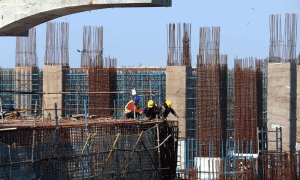
On the development side, the mega project so lovingly spoken off by the political system as a panacea for taking care of the ills will not be so easy to deliver as the time sequence is important. The political system caters for short-term solutions, as all the political parties are short on time. That is why the development of ad hoc interventions tends to be more consumption-oriented. Employment cannot be served by the taxi scheme. The requirements for the unemployed are many. In any case a difference has to be made between the requirements for rural areas and for the urban policies. At the moment Pakistanis are witnessing mass protest. No political party or the nation need be happy at what is going on for this will create a massive wage-price inflation. The West has emerged from this. The economic system was always afraid of this vicious circle. The technicians are out on the street and the less salaried will soon be protesting against the non-transparent policies that affect the price structure. What is the impact, for instance, of ad hoc decisions on the inputs to an economy or what happens if the system starts bleeding because of the corrupt practices of the few? Is the bureaucracy above board? Are the politicians beyond reproach? Is the business community doing all it can to stop heating the economy? Are the internationally-traded goods purchased in a manner that the effect on the economy is minimised? A number of questions comes to mind. These are difficult to be implemented in the short-run, but as said before a beginning has to be made no matter how crude, or we should be prepared for the same sort of muddle that we have been witnessing.
Let us look at the KB and Bhasha Dam. A certain section of the engineering community as well as the farmer organisations have been rooting for these projects. The cost is exorbitant and the financial resources are not available in the country. The financial gap has to be made up from international borrowing. The gestation period is far too long and will be made more so because of our inefficiencies. The Cost/Benefit (C/B) analyses have always been tilted by the formulators of these projects and since every aspect is to be in the future that means that the C/B is incorrect. Such mega projects are generally conceived on fear factor. The most important of this fear factor is food security. The engineers have played this well. So when any expansion planning is conceptualised then the need is for the determination of systems design to go in to place in a manner that takes into consideration not only priorities but also effective coming on board of the mega projects so that the benefits of the project are available to the economy.
Space and time limitations have only allowed me to touch the tipof an iceberg. More later when the specific interventions for the agriculture as well as the industrial sector would be taken up.












Comments
Comments are closed for this article.