


While the Punjab is restive on account of the unbearably long hours of power loadshedding, and Khyber Pakhtunkhwa and Balochistan on account of terrorism, Sindh is living through an extended period of ethnic violence. All these are reflections of the governance of the state under a "peoples" democracy.
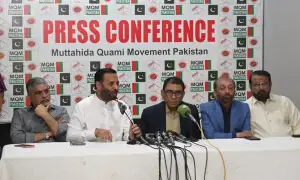
In Sindh, the setting portrays pervasive insanity and complete apathy of the regime in power; each coalition member (PPP, MQM and ANP) wants to rule Karachi to the exclusion of the other two. The MQM - part of the mess created in the last four years - has finally warned the regime about the anarchy becoming the new order. An early riser, isn't it?
Collectively, the conduct of political parties reflects one priority - domination of the city that, at least thus far, had the capacity to absorb millions unquestioningly, and provide them jobs that could earn them a livelihood. But the greed of the coalition partners may soon deprive Karachi of these big pluses.
No city in the world, no matter how big an economic 'power' house it may be, can stay that way if its factories, goods and labour markets, even petty retail stores, stay shut for days at a stretch as is the case with Karachi now. Freezing of economic activity eventually leads to closure of businesses of all kinds and sizes.
Of the many self-damaging traditions that the regime loves to pursue, one is to freeze economic activity to express its anger at an historical or recent tragedy. How this culture will help an economically stressed Pakistan is a question that no political party is willing to answer. So much for their self-proclaimed patriotism!
Undoubtedly, the killing of the innocent must be condemned in the strongest possible terms because it is an unpardonable sin, and those perpetrating this crime must be brought to justice. If that isn't done, it will induce more to commit such crimes - a tragedy that is bleeding Pakistan, but can strikes assure that outcome?
This reaction never achieves that aim; only temporarily it makes the administration pretend that it the rounding up the culprits but in essence, it reflects on the apathy of the administration towards meeting its obligations, and the high cost of such wake-up calls. What sort of governance does it reflect? Democratic, I guess.
Should an administration under a self-professed peoples' regime require such prodding, and should the cost of waking it up be as high? Even if you disregard the broader economic cost of it, the fact that, for days the daily wage-earners earned nothing to support their existence is shameful for a 'people-friendly' regime.
Those who had to starve for days surely didn't pray to God to bless the souls of victims of targeted killing. Who then got the benefit of the shutter-down strikes? The political parties; they sponsored the protests to show their might in freezing economic activity; boasting that activity does not form a part of their mandate.
What the shutter-down strikes would eventually lead to is joblessness of the very millions (especially the daily wage-earners) that the city now employs. The sort of chaos the unemployed millions can cause isn't hard to imagine for the sane, but not for the 'democrats' that are causing it right now in Karachi.
The sentiments this scenario nurtures among the hungry and jobless millions are identical - intense hatred for the governance system - be it democratic or dictatorial. That is precisely what's happening now. Today, the staunchest supporters of democracy have become the peoples' greatest enemies.
But, that's not as contradictory in terms as it appears. How many of the self-proclaimed 'democrats' actually believe in democracy? If cronyism and nepotism is all that democracy is about, then we certainly have democracy. But if that's not the case, what we certainly don't have is democracy.
Shutter-down strikes that have grown in number since the incumbent regime took power, reflect its blindness to the ground realities of Pakistan - power shortages, falling economic activity, multifaceted supply shortages, rising unemployment and poverty. But the regime appears least concerned about all these suicidal trends.
The loss of each day's economic activity adds to these self-damaging trends but, to the politicians who appear to place economy at the lowest priority, it matters not. In spite of this profile, they all claim their right to lead the nation, God alone knows where to. For now, the destination seems a bottomless pit.
The result of cronyism, nepotism and corruption is, that on the one hand, public sector enterprises are being burdened with over-staffing, and on the other shutter-down strikes are sapping the productivity of these units that, in any case, can't survive given their crippling levels of debt and staffing burdens.
The more worrying aspect of this scenario is that even the private sector enterprises - now the only truly productive entities - too are being forced to freeze their operations. In a way, they too are steadily being pushed into the bottomless pit that has become the destiny of the public sector enterprises.
Where will this gross mismanagement lead to? Wouldn't economic growth come to a standstill, in fact go into the negative? With the rise in population practically uncontrollable in spite of the great 'family planning' programmes of the state, how will more mouths be fed out of the declining economic output?
Isn't it time the 'democrats' realised that freezing of economic activity too often will definitely lead to much higher unemployment and chaos that would be simply be uncontrollable by the tiny civil armed forces, compared to the country's population? Will the 'democrats' be able to protect themselves, let alone the masses?
By ignoring all this and engaging in fighting among themselves, the political parties are (in the common perception) turning into 'warring gangs'. Should this be the perception about those who have popularly (really?) been mandated to legislate laws that make Pakistan an ever-more self-sufficient and civilised state?
The fact that both the ANP and the MQM keep asking for military intervention to control the law and order in Karachi, is a manifestation of their 'success' in managing the affairs of the state. As for the PPP, its sole focus is on proving that it has no share in the chaos; the ANP and MQM are responsible for it. What a coalition we have!
It is time all these 'coalition' members realised that the black sheep in their ranks are exposed, caught, and brought to justice. That's the only way to regain a shade of credibility for governance. Should they fail (courtesy the visionless in their ranks) they don't stand a chance in the next elections. That's the writing on the wall.












Comments
Comments are closed for this article.