


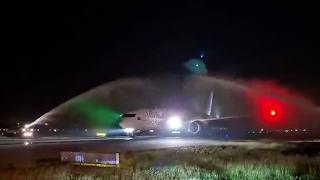
South Sudan plans to mark its emergence onto the world stage as an independent oil producer by completing a new airport terminal in June as a showcase for business visitors to the capital Juba, a government official said on Thursday. "It is our highest priority," Deputy Transport Minister Mayom Kuoc Malek told Reuters. Money for the prestige project has now been secured, after funding problems and other snags prevented its completion in time for independence celebrations last July, he said.
Some 22 airlines serve Juba International Airport, mostly from African neighbours such as Kenya and Ethiopia, and South Sudan has long wanted to replace the elderly airport building, with its poor security and long bench instead of a luggage carousel. The new terminal will show the modern face of South Sudan to the rising number of foreign executives tapping high-risk, high-return business opportunities in the central African state.
Malek, speaking on the sidelines of an investment conference, said the government is confident it will also obtain funds to extend the airport runway and build a new taxiway within two years. "We are rehabilitating the runway. It hasn't been repaired for a long, long time," he noted. After decades of north-south civil war in Sudan, a peace agreement in 2005 allowed the south to secede, which it did last year, becoming South Sudan on July 9.
The new government has found it difficult to assert control over its territory and launch infrastructure projects, and President Salva Kiir routinely cites corruption as a barrier to development. Malek said that South Sudan hoped to secure funding from private investors or international organisations to build three new airports, including one in the Tali area to serve Ramciel, where the government plans to move its capital at some point, and one in Bentiu, in oil-producing Unity state.
"This is long term," he said, declining to specify the time frame or sources of funding. "As a landlocked country we need good access." The government also plans to move its main port on the White Nile from Juba to Mangala in the centre of the country, he said. The new port will be a hub to serve Uganda and other east African countries. "River transport is the cheapest," he said. South Sudan used to import many of its needs from Sudan via Nile trade, but the land borders have been closed for most of the time since independence because of tension and fighting on the Sudanese side of the border.











Comments
Comments are closed for this article.