


The Government of Bangladesh firmly believes that gender equity is more than a goal itself. It is a precondition for meeting the challenge of reducing poverty, promoting sustainable development and building good governance.
Bangladesh has made substantial progress in women empowerment. One of the key objectives of Bangladesh government's development plan is to eliminate gender discrimination and establish women's equal rights for over all progress of the country. The Constitution of Bangladesh is the basis for women rights and advancement. After independence of Bangladesh in 1971, a significant number of initiatives and institutional measures have been taken by Father of the Nation Bangabandhu Sheikh Mujibur Rahman to eliminate gender discrimination in every sector of the country.
In continuation to those initiatives, the government of Prime Minister Sheikh Hasian is working for eradicating poverty, reducing gender disparity, providing health-care facilities, human resources development and incorporating women in the mainstream economic activities. The National Women Development Policy-2011 and the National Children Policy 2011 have also been formulated in this connection.
After the period of Beijing Platform for Action, a remarkable progress has been made in the field of women advancement regarding education, health, economy, politics and human resources development in Bangladesh, which helps upgrade the status of women in every sector in the country.
The government has taken initiatives of free education for girls up-to 12 grade, stipends and financial supports for buying books and reading materials to promote female education. As a result, the enrollment of female students has increased in primary and secondary levels. The health status of women has improved, the rate of child and maternal mortality has reduced due to effective initiatives of government in the health sector.
The participation of Women in economic activities has remarkably increased, especially in industrial sector. Women entrepreneurship or "women in business" has gained importance and acts as a very recent phenomenon in Bangladesh. A developing country like Bangladesh, where SMEs are the engine of growth, the emerging new class as the SME women entrepreneurs in both the urban and rural areas is now turning the situation as a crucial progress in national development.
Despite many barriers, the new women's entrepreneur class in the Small and Medium sector has developed in the country taking on the challenge to work in a competitive and complex economic and business environment. Women as entrepreneurs have turned successful as manufacturers, exporters, importers, order suppliers, business agents, boutique owners and product designers by taking up challenging tasks previously unknown to them and initially posing as risky, uncertain and perilous. Their status in the society has enhanced and they are now given importance as entrepreneurs. It has been found that at present women entrepreneurs not only have improved their living conditions and earned more respect in the family and the society, but they have also contributed to business and export growth, supplies, employment generation, productivity and skill development.
Microfinance has been heralded by some as a "magic bullet for women's empowerment". Women's access to credit strengthens their bargain power within the household, improves perception of self worth and leads to a decrease in domestic violence.
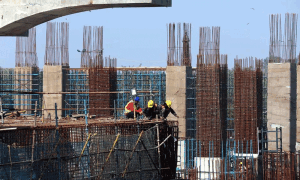
More than 85% workers in the ready-made garment industry in Bangladesh are women. Women are also working in large scale in other industries such as leather, cosmetics, pharmaceuticals, food processing etc.. They are also self-employed in non-formal economic activities. Women are engaged in agriculture, livestock, forestry, fishery and other economic sector. There is a growing trend of women working in construction sites. The women of Bangladesh are also participating in international labour markets.
The above developments have been possible due to the government initiatives and policies to create working conditions conducive for working women. Some of these initiatives and policies are elaborated here. To create the workplace more women friendly, the government has set up a number of day-care centers in different workplaces and has extended maternity leave for the female government employees from four months to six months. Social safety net programs are one of the main components of government's development activities for ensuring economic and food security for poor women of the country. Under this safety net programs, different types of allowances and food grants have been distributed to 9, 20,000 destitute and poor women in all over the country last year.
The situation of women's political empowerment in Bangladesh is momentous. We have 64 female parliamentarians in the National Parliament, among them 19 women have been elected through direct elections and 45 women have been nominated. Five women Ministers are in the Cabinet responsible for five important Ministries e.g. the ministries of Agriculture, Foreign Affairs, Home Affairs, Women and Children Affairs and Labor and Manpower. The government has passed the Local Government bill to ensure women participation in grass-root level. As a result, 14,228 women have been elected at Union Parishad level as UP members through direct elections and successfully running their offices.
The current Parliament has approved the rights of Bangladeshi women to marry foreign citizens and also created the provision for children to get the citizenship of their mother through revision of the Nationality Act 1951.
The government is operating a central prevention cell for Violence against women in order to provide legal assistance at the Ministry of Women and Children Affairs. Violence against Women Prevention Cell is also working through the Department of Women Affairs in all Divisional cities and Faridpur District town. Various types of legal aids are being provided for destitute women by these cells. Apart from these, there are Shelter Homes and Safe Custodies for women, children and adolescent girls. Helpline for the victims of violence has been incorporated with the One Stop Crisis centre in each of the divisional medical college hospitals.
In order to prevent violence against women, a number of Acts have been revised and formulated. The Cabinet has approved the 'Domestic Violence Act, 2010' in February 2010.
Bangladesh is a signatory to all international legal instruments relating to the protection of rights of women and discrimination against them. Bangladesh is an active member of the UN bodies such as UN Women, Committee on Status of Women and CEDAW. Bangladesh has been elected as member of the CEDAW getting highest 153 votes for 2011-2014 terms.
As a recognition of this initiatives, Prime Minister Sheikh Hasina has been awarded the South-South Award-2011 on 19th September 2011 during the 66th Session of United Nations General Assembly for the government's outstanding contributions to improving the lives of women and children through Digital Bangladesh Programme. UN Economic Commission for Africa, Permanent Mission of Antigua and Barbuda to the United Nations, International Telecommunication Union (ITU) and South South News jointly introduced the awards. The Award is a recognition of the government's success in the field of health, specially improving lives of women and children and counter terrorism. Bangladesh received an UN award for its remarkable achievements in attaining the Millennium Development Goals (MDGs) particularly in reducing child mortality rate. Prime Minister Sheikh Hasina accepted the award on 19th September 2010 during the 65th Session of UNGA in New York.
Bangladesh has been highly lauded globally as a country promoting secular, progressive values, countering extremism and a "rising star" in women empowerment by UN Secretary General Ban Ki-moon and other global leaders in the 65th UNGA High Level Segment on MDGs.
Compiled by: Mrs Sarah Siddika















Comments
Comments are closed for this article.