


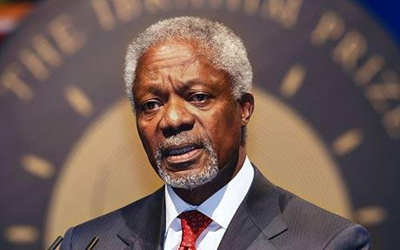
 Hopefully, the opposition being put up by Russia and China against outside dictation on the Syrian situation is relenting. Both the countries have helped adopt unanimously a UN Security Council statement along the lines indicated by the joint UN-Arab League envoy to Syria, Kofi Annan, after his recent visit to Damascus. The flexibility shown by them stems as much from their better comprehension of the evolving situation in Syria which remains explosive, as from the fact that the Annan's six-point proposal aptly matches their positions. Should the UN Security Council come up with a joint resolution carrying forward his proposal for a concrete follow-up action the chance of the Syrian situation taking a turn for the better would considerably improve. Annan has proposed for a cease-fire first by the Syrian government and a daily two-hour halt to fighting to facilitate humanitarian work in the strife-ridden areas and "inclusive Syrian-led political talks". Mercifully, he doesn't support military action, nor envisages punitive sanctions against the Syrian government, apparently convinced that the last year's UN-mandated foreign military intervention in Libya had proved to be counterproductive. However, the UNSC-adopted statement doesn't completely rule out such an eventuality if it becomes unavoidable, by obliquely hinting "further steps" if the Syrian government failed to comply with the Kofi Annan's six-point proposal. Russia and China had twice vetoed UN Security Council resolutions on Syria, citing concerns that the world body was taking sides. And they were largely right. While some of the European powers were itching for military action and regime change in Damascus, and there was also some evidence of them being channels for arms being smuggled to the Syrian revolutionary, the Arab countries were for giving international diplomacy a chance. Over time however, as the uprising began taking on the colours of a civil war with the clear threat of it endangering regional stability and things getting out of control in the oil-rich Middle East, the option for a deeper insight into the Syrian crisis came to the fore. There is the perception that the Syrian uprising is not as much the feat of Arab Spring and is essentially home-grown and inspired by people's rejection of the decades-old despotic rule by the 'House of Assads'. Having failed to quell the revolt by employing normal weapons of control, the Syrian government has now resorted to using heavy weapons like tanks and rockets in the so-called strongholds of the opponents. And there has been some success, with revolutionaries moving out of the cities. But there is also this dangerous change of their perceived tactics; they seem to be increasingly using sabotage as their principal weapon of war, the recent spike in incidents of suicide bombing and torture of adversaries being the evidence. Even more dangerously, there are fears that the al Qaeda may have joined the fray. After a string of bombings near government security buildings in Damascus and Aleppo US officials suggest al Qaeda militants may be involved. A hitherto unknown group called Al-Nusra Front to protect Levant has claimed responsibility for the recent bombings 'to avenge the people of Homs'. Given that the Assad regime is never short of excuses to justify its acts of brutality it may be behind these bombings to hog Western sympathies. Or, maybe the al Qaeda is actually there in Syria to exploit the sectarianism which remains combustible in Syria where the minority Alawite sect rules the roost to the utter frustration of the majority Sunnis who now are the revolutionaries' main supporters. By all markers, the Syrian turmoil tends to continue with the clear possibility that it may lead to civil war. But, quite paradoxically, with Russian and China backing the Kofi Annan proposal, the chance of finally finding a way out of this imbroglio has also considerably improved. Perhaps, the 'butcher of Damascus' couldn't have lasted so long without the support he drew, albeit vicariously, from the positions taken by Russia and China. With them endorsing the Kofi Annan proposal, the Syrian dictator should see the writing on the wall and come to the table. That is the only way to save Syria from total chaos and anarchy. Copyright Business Recorder, 2012

















Comments
Comments are closed for this article.