


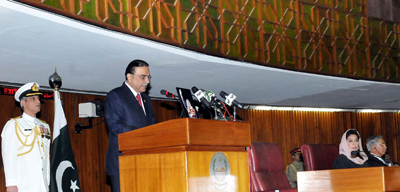
 President Asif Ali Zardari has successfully delivered a record fifth consecutive address to the joint sitting of Parliament. Credit above all goes to him for successfully managing to turn his political foes or forces hostile to his rule into coalition partners. Nawaz Sharif too deserves some praise for helping the government complete its constitutional tenure. His refusal to become a pawn in the hands of the Establishment to topple an arguably corrupt government through extra-constitutional means has been no less important. Media as well as higher judiciary also have played a vital role towards strengthening a fledgling democratic process. And, kudos to Chief of Army Staff General Ashfaq Pervez Kayani for resisting pressures and temptations both from forces within and outside the Parliament to dislodge the government. The chattering class is indeed bewildered why non-democratic forces have stayed their hand or not acted in any harmful way in contrast to dismissal of elected governments on much lesser follies in the past. In a parliamentary system, Presidential speech - the work of government's 'active' imagination - is usually the handiwork of the incumbent government itself. Extolling government's achievements, therefore, is the norm in all democratic and quasi-democratic set-ups. But so is presenting the game plan or the unfolding of vision for the next year. It is on the second score that Presidential address profoundly falls short of expectations. It needs to be conceded that the present PPP-led coalition did inherit a battered and bruised economy and a Federation riven by serious differences, including the simmering Balochistan cauldron following the killing of Nawab Akbar Bugti. The Parliament has indeed strengthened federalism with unanimous passage of 18th Amendment and to the Federating Units for agreement on the 7th NFC Award. The adoption of 20th Amendment has given birth to some legitimate expectations with regard to transparency and fairness of general elections in future. State functionaries and the civil service need to be fully empowered and legally protected to refuse illegal orders and stay completely neutral in allowing the people to exercise their choice through the ballot. Unfortunately, however, both the PPP-led coalition in the Centre and Sindh and PML(N) in Punjab have miserably failed precisely on this score. The starting point for structural reforms and lead the country on a higher growth path has to stem from civil service reforms for improvement of delivery process at all the three tiers of government. The recommendations provided in a report prepared by the Ishrat Hussain Committee have been largely ignored. Second, the political leadership has failed to implement the recommendations of its economic team to stop the fiscal haemorrhage. Preparing the bleeding public sector entities for privatisation because governments have no business to run businesses has been strongly resisted by almost all political parties, including the ruling coalition. This is a sure recipe of disaster because the condition of each public-sector entity is worsening in the absence of good governance, transparency and a strong appetite for competition aimed at increased productivity and revenues. Council of Common Interest and the Senate were created by the framers of the constitution so that the Federating Units can resolve even the most contentious issues between the Centre and provinces and among themselves. So, make the best use of these two fora. And, induct technocrats in ministries which require specialisation. Third is the failure to plan to meet the energy deficit from domestic sources rather than imports. It seems that our planners have not learnt from past mistakes. Even the strongest country in the world, ie, the United States of America, has clearly seen the need to reduce its dependence on imported oil from Middle East. Pakistan, on the other hand, is striving to meet the energy deficit through import of natural gas from Iran, Qatar and Turkmenistan instead of investing into production of local coal, alternate energy (wind and solar) as well as hydel. Rental power was claimed to be a quick fix but has not been cheap. Similarly, imported natural gas will not be economical. We owe present predicament to a wrong energy mix. We need to reduce our dependence on imported oil as oil is destined to remain above $100 a barrel for the foreseeable future. Escalating US-Iran stand-off only contributes to such oil price hike fears. Creating the infrastructure to provide energy, water and transportation to the businesses at a cheaper price to compete for export in the world market does require state patronage. Cheaper credit and fiscal incentives alone are not sufficient measures for business to thrive and provide employment to burgeoning armies of unemployed youth. It needs to be conceded that major reasons behind low growth and repeated fiscal slippages are the unprecedented damage on account of floods for two years in a row. The leadership in government's economic team has the right credentials and could have performed better if the political leadership - President Zardari and Prime Minister Gilani - had been more supportive to its initiatives. Pakistan was eased out of an IMF SBA as the political coalition could not muster the required number of votes to turn the commitment on Value-Added Tax (VAT) into a reality. Similarly, electricity and natural gas shortages continue to plague the economy due to poor policy and shoddy enforcement. The Gilani government, however, did manage to create political support for war against terror and a leadership to look more towards the eastern front for better trade relations. The initiative on poverty reduction through the Benazir Income Support Programme could garner more votes for PPP at the hustings but is yet to reverse the rise in poverty. Creating jobs would require the economy to grow 7 to 8 percent for at least a decade. Consistency in policies would help the economy grow on a sustainable basis. Democracy in Pakistan may have shown some strong signs of maturity. The democratic consolidation path should be combined with a path for economic consolidation. And now, last but not least, in the upcoming general election. The PPP has good prospects because Asif Zardari, the man who turns foes into friends, still has that miracle in his name. Copyright Business Recorder, 2012














Comments
Comments are closed for this article.