


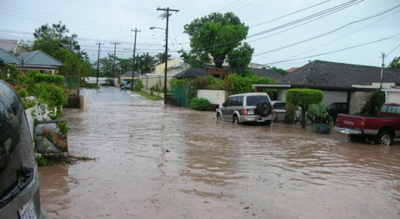
 Speaking at a disaster management event in Peshawar the other day Country Director of UNDP, Jean Luc Stalon, pointed out that Pakistan is among the countries hardest hit by global warming, where climate changes are happening fast. In fact, environmental experts have been warning for a while, of impending cycles of floods and droughts and rising of sea levels due to glacial melting. Just last year this country experienced the worst floods in living memory, which caused widespread havoc in swathes of Khyber Pakhtunkhwa, south Punjab and Sindh. More than 1600 people lost their lives while millions were rendered homeless and their cattle and crops destroyed. It remains to be established whether or not that was the result of a natural phenomenon or man-made disaster. Yet the experience underscores the need for better preparedness both for the short and longer-term. The government must pay serious attention to the issue and take necessary steps to deal with any eventuality. For the short run, at least three measures are in order. First of all is the need for an efficient early warning system so as to reduce disaster risk. Second, the Disaster Management Authority has to upgrade its rescue and rehabilitation preparedness. True, last year's calamity was too large a scale for the country, still loss of life and property could have been minimised had there been a proper plan and infrastructure in place. Third, provincial governments must build embankments and dykes wherever necessary to protect population centres from river overflows. Yet another necessary measure pertains to unplanned expansion of human habitations, particularly in the flashfloods-prone parts of Khyber Pakhtunkhwa. They block the flow of water to natural drainage areas, causing harm to life and property. The problem ought to be addressed and prevented from causing further aggravation. The bigger issue of warming, of course, is generated by growing industrial activity in and around this country as well as other sources of greenhouse gas emissions. Which is uncontrollable in the foreseeable future. But there are other things that can be done to reduce greenhouse gas emissions and thwart environmental damage. In this regard it needs to be noted that a significant factor of environmental degradation, especially in the northern areas worst affected by last year's flashfloods, is illegal logging. A report quoting FAO says between 1990 and 2010 Pakistan lost an average of 42,000 ha of forests per year. According to this report, only 2.2 percent of Pakistan is forested. The government though makes exaggerated claims. Two years ago ie, before the FAO mentioned the 2.2 percent figure, the environment ministry was talking about 4.8 percent forest cover saying Pakistan was trying to ensure environmental sustainability by increasing its forest cover from 4.8 percent to 6 percent and protected area coverage from 9.1 percent to 12 percent by 2015. However, even as the government claims are inflated, there are some indications of progress being made. More honest and focused efforts are required to promote forestation. Copyright Business Recorder, 2012



















Comments
Comments are closed for this article.