


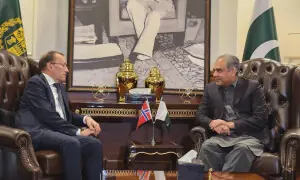
The European Union (EU) would provide Euros 30 million (Rs 3.52 billion) for Sindh Education Sector Support Programme to improve quality and access to public education in the province. The financing agreement was signed on Thursday by the European Union Ambassador to Pakistan, Lars-Gunnar Wigemark and Secretary Economic Affairs Division, Dr Waqar Masood.
The objective of the EU support to the provincial government is to promote quality of education and ensure access in primary and secondary education. The financial assistance would also assist the Sindh province to achieve the education-related Millennium Development Goals.
"The European Union firmly believes that improved quality and access to public education is essential for the youth of Pakistan," the EU Ambassador said while speaking on the occasion. He said that Pakistan and EU have been engaged in development co-operation for the last 50 years adding that the EU financial assistance portfolio stands at Euros 395 million in Pakistan in various sectors, particularly in education.
He said that the current assistance was being announced at a time when World Women Day is being celebrated, hence underlining the importance of ensuring women's access to education for the better development. The Ambassador said that EU support will furthermore assist the Sindh government to improve management and service delivery in the education sector adding that EU was providing support for a similar for the Khyber-Pakhtunkhwa province.
On the occasion, Dr Waqar Masood assured the ambassador that EAD would provide all out support to EU programmes for their completion on stipulated time and thanked the EU for extending support for education sector of the country. He said that the support would help Sindh province provide quality education to its people besides helping it to increase access to education to its people.
He also thanked European Union for successful Pak-EU Joint Commission meeting in February. It is pertinent to mention here that under the Sindh Education Sector Support Programme, the provincial government would be approving a coherent education sector policy and plan for which it would conduct a structured and inclusive sector review and dialogue with all education donors and civil society.

















Comments
Comments are closed for this article.