



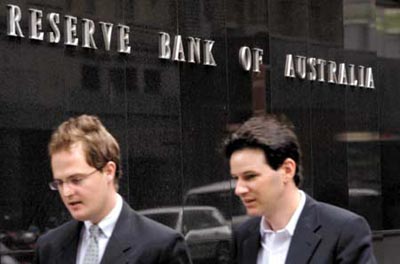
 SYDNEY: Australia's central bank chose to cut interest rates this month because of the dangers the European crisis posed to global growth, even though some factors suggested there was no strong need for an easing, minutes of the December meeting showed.
The Reserve Bank of Australia (RBA) noted booming business investment and an overall economy that was growing broadly in line with trend. They also considered still solid growth in the country's major trading partners, particularly those in Asia.
"This did not suggest any strong need to cut interest rates," the minutes, released on Tuesday, revealed.
Indeed, third quarter data released a day after the Dec. 6 board meeting, showed the economy grew a brisk 1.0 percent thanks to very strong business investment and surprisingly healthy household consumption.
The Board, however, felt the downside risks from Europe has increased and warned of slower global growth next year.
"It seemed highly likely that the sovereign credit and banking problems would weigh heavily on economic activity there over the period ahead, and there was a non-trivial possibility of a very sharp contraction," the minutes said.
"Overall, members concluded that growth in the world economy was likely to weaken over the coming year."
As a result, it decided to lower the cash rate by 25 basis points to 4.25 percent, the second easing in as many months.
As usual, the minutes gave no hint of the RBA's next rate move. But the Australian dollar climbed nearly 30 pips to a session high at $0.9941 as markets had been bracing for a more dovish statement, traders said.
"The RBA looks to be keenly focused on assessing the spillover from Europe to Australia's trading partners and the domestic economy before judging the needed response -if any - for rates in Australia," said Scott Haslem, economist at UBS.
"We see the subsequent deterioration in European financial markets and credit conditions - as well as some recently weaker domestic data - as likely to foster a further cut from the RBA when it next meets in February."
Fears that Europe's debt problems will hit global growth have driven the local market to price in more than 100 basis points of easings next year, taking the cash rate below 3.0 percent -- lows not seen since the 2008 global financial crisis.
RBA policymakers noted the considerable turbulence in global financial markets and the increasingly difficult financial conditions for banks, especially in Europe.
But they saw no signs of strain in the local market markets, with Australian banks benefiting from the shift of US investors away from European bank debt.
The RBA said recent surveys pointed to a very strong business investment outlook, with the LNG sector continuing to expand and new iron ore and coal projects coming on stream.
However, it acknowledged the housing market remained subdued and pointed to moderate employment growth that is well below the pace in 2010.
Liaison with employers pointed to significant caution in hiring and contained wage pressures.
"In these circumstances, and given the expectation that inflation would be consistent with the target over the next couple of years, members felt that there was scope for a modest reduction in the cash rate at this meeting," the minutes showed.




















Comments
Comments are closed for this article.