


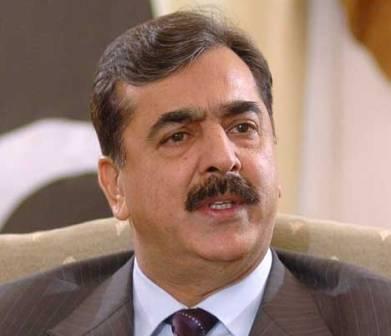
 "Something is rotten in the State of Denmark [read Pakistan]." Marcellus, who is one of the guards on duty, says this when the ghost of young Hamlet's father, King Hamlet, appears. He means that there are strange and evil events occurring. The simmering perceptional mismatch over the basic question of the separation of powers has come to a head, thanks to Prime Minister Gilani's roar in the parliament and outside on Thursday heard far and wide. Does the hard line that he took suggest that the government is panic-stricken and is on the run, or what he said was an expression of defiance? Or, was he trying to bear pressure on the judiciary that is presently hearing the Memogate case, as some of the government's detractors insist. There is no clear answer to any of these questions, yet. But one thing must be accepted at the very outset: there can be no two opinions about the fact that all state institutions are subject to the parliament's oversight, and there can be no 'state within a state' - which Prime Minister had asserted alluding to the army high command's perceived decision to fight on its own, its case before the apex court. But that said, one must not forget that all democratic constitutions see to it that the time-honoured concept of the 'separation of powers' remains a fundamental principle of statecraft. In the words of Montesquieu, whose concept of separation of powers greatly influenced the bills of rights of American and French constitutions and continues to do so in liberal constitution-making everywhere else, the liberty in England can be rightly ascribed to the 'separation of the legislative, executive and judicial powers, and to the balancing of these powers against each other'. Yes, the parliament is supreme but to the extent of making laws; which are rightfully implemented by the executive and interpreted by the judiciary. What the Supreme Court is doing is simply performing its role of interpretation; it's looking into the admissibility of the petitioners' case whether the Memogate affair fits the definition of "a question of public importance with reference to the enforcement of any of the Fundamental Rights conferred by Chapter I of Part II" of the Constitution. The prime minister doesn't like that; it's beyond one's comprehension, for his very oath binds him to discharge his duties and perform functions strictly "in accordance with the Constitution". How come the Chief Executive doesn't want to be part of the Memogate proceedings in the Supreme Court? And, his stand that since the Parliamentary Committee on National Security is already investigating this scandal - to which the Supreme Court has no objection - the apex court's hearing is unwarranted doesn't pass the test of legal scrutiny. The parliamentary committee at best can pass an unbinding resolution but has no powers to define a Fundamental Right and recommend its trial by an appropriate court. If the Memogate scam is a 'question of public importance', in all fairness that question stands answered already. And no less importantly, given the political opposition's skepticism about the parliamentary committees to deliver on this issue - of course after its initial acquiescence - makes it all the more hard to believe that its verdict would satisfy the masses. Then no less untenable is Prime Minister Gilani's averment that a military coup is in the making. At this stage, and perhaps in foreseeable future, there is no scope of military take-over in Pakistan. The issue that the country should have undiluted democracy is settled once for all and this optimism is as much the product of people's aspirations as of the power- centers that in the past had nurtured or staged or legitimised coups. Firstly, the entire political opposition is deadly opposed to a military take-over whatever the reason. It has been repeatedly asserted from every available platform by all major political players and there is no room for Bonapartism. Then, there is the Supreme Court's abundantly-clear message that military coup will not be tolerated, what to talk of its legitimisation. And finally, if the Army Chief General Kayani and ISI chief Lieutenant General Pasha have submitted ' independent' replies to the petitions they did so because the court wanted it so as they were made respondents in their individual capacities. At no stage did they ever say the government has involved. Their pleas are for an in-depth probe into the Memogate case and there is no disagreement that it is an issue of immense importance as it tends to undermine national security and is a blatant attempt at degrading the morale of the troops. As stated by the army chief that military will continue to support democracy in Pakistan and these speculations of a military take-over are aimed at diverting focus from the real issues, nothing on the ground suggests that a move is afoot to bring down the government and fears to that effect are unfounded, but at the same time there is no escape for any of the institutions to clear the air on this Memogate scam when seen in all its alarming dimensions. Copyright Business Recorder, 2011




















Comments
Comments are closed for this article.