


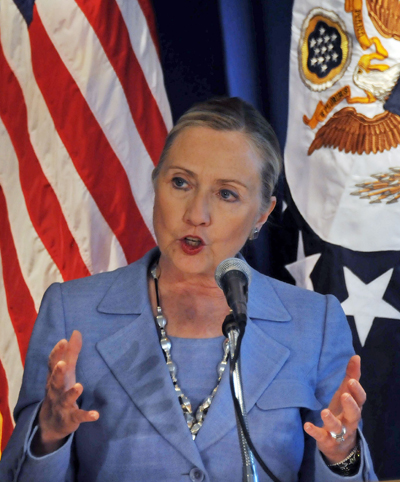
 Hillary Clinton's recent visit to Myanmar is being described as historic because it was first such visit by a US secretary of state in 50 years. No less important is the fact that the top American diplomat spent three days in a country that has remained a virtual pariah since a military junta staged a coup following national election in 1990. Aung San Suu Kyi, leader of the National League for Democracy, believed to have won the election, was thrown first in jail and then put under house arrest, from where she was released only a year ago. The military still wields political power, but with a civilian face. President Thein Sein is a retired general. Things started easing off somewhat about a year ago with the regime introducing some reforms, holding dialogue with the opposition and releasing some prisoners. The US and Myanmar obviously have taken a fresh look at one another and discovered mutual attraction. Although a resource-rich country, Myanmar has one of the world's least-developed economies. Pro-democracy sanctions imposed by the Western countries further aggravated the problem although a lot of trade and investment activity has gone on with China. When rebuffed the regime pretended not to care, now courted it is eager to seek international rehabilitation. Clinton offered important incentives such as facilitating access to IMF loans, and UN's health and microfinance programmes as well as upgradation of diplomatic relations. For that to happen, the government is being asked to release all political prisoners, stop suppression of ethnic minorities, and improve human rights conditions in general. Given the nature of the regime, it is unlikely to easily deliver on any of these reforms. It may make some concessions here and to enable the US justify normalisation. If the example of the NRO case in Pakistan is anything to go by, the US may well be brokering some sort of a reconciliation deal between the government and the Opposition. Clinton had at least two intensive meetings with Suu Kyi, who ever since her release, has been showing a willingness to participate in elections under the present set-up. As for the US, its new-found interest in Myanmar seems to be linked to a shifting global balance. In a rather unusual gesture President Obama sent, through Clinton, two letters one addressed to Suu Kyi and the other to President Sein. The one from one president to the other offered a "new phase" in ties, requesting "tangible outcomes" from the ongoing reform effort. The offer holds significance in view of the fact that the US is in the process of readjusting its security posture in Asia with an eye on China's increasing influence. Unsurprisingly, reports suggest that the Clinton visit created much unease in Beijing. Although the Chinese government welcomed the development, official media expressed concern. Hopefully, this big power rivalry will benefit the people of Myanmar rather than its authoritarian rulers. Copyright Business Recorder, 2011




















Comments
Comments are closed for this article.