


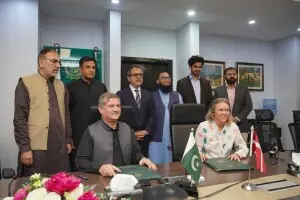
Prime Minister Yousuf Raza Gilani while inaugurating the 71st annual session of the Pakistan Engineering Council in Lahore stated that the people of the country would get used to power outages, if they were scheduled. One may commend the Prime Minister's inherent grasp of human nature that accounts for us, as human beings, to take considerable abuse in ever larger doses if forewarned; yet as a politician his remark will be denounced as a reflection of the complete lack of sensitivity to the needs of the people who voted his party to power.
He would be well-advised to note that the erosion of public patience may, in time, have political ramifications for his party. The Prime Minister, as usual, laid the blame squarely on the flawed policies of the previous government. He did not mention that the PPP is in coalition with the PML (Q) at the centre as well as two important ministries namely the Ministry of Finance and Foreign Ministry are currently held by individuals who held portfolios in Musharraf's cabinet.
However, the Prime Minister claimed that 3,000MW has been added to the system, a claim that is challenged by credible figures as the only installed rental power project (RPP) to date (Karkey) is operating at far less than optimum capacity. Gilani added that the RPPs could have resolved the energy crisis but the government was forced to back down as 'some elements raised a hue and cry'. This contention reflects an obvious but disturbing fact, namely that the Prime Minister simply did not bother to read the third party audit that was supported by his cabinet at the insistence of the then Finance Minister, Shaukat Tarin.
The audit clearly noted four disturbing elements: (i) RPP agreements were 'signed in haste' without examining the government's fiscal and contractual obligations in detail. In some instances the agreements were changed by the Private Power and Infrastructure Board after the completion of the bidding process to favour the sellers. In addition, the project efficiency committed by the sponsors of RPPs was for only 32-35 percent but the government legally bound itself to make payments for 90 percent capacity utilisation; (ii) declining gas flows and uncertainty surrounding installation of compression facilities at Qadirpur gas field could not guarantee full utilisation of the capacity of those RPPs reliant on gas as fuel, as the case of Karkey reveals; (iii) the tariff increase would be considerably higher than that calculated by the Ministry of Water and Power.
The audit revealed that in the unlikely event that gas was supplied to all the RPPs then the tariff rise would be 31 percent but if full gas supply was not possible and capacity utilisation was based on furnace oil, the required tariff increase would be no less than 45 percent; and (iv) the existing logistic infrastructure did not match transportation requirements of the additional fuel oil needed for new RPPs. One would urge the Prime Minister to revisit the third party audit prior to defending the RPPs.
The Prime Minister also claimed that the PPP government had evolved a consensus on the Diamer Bhasha Dam (a project announced by Pervez Musharraf in 2006) and initiated the Thar coal projects at the Council of Common Interests. He did not note that neither of these projects are opposed by any political party and have instead been delayed because of lack of resources and the failure of successive governments to formulate an effective policy to attract investment (foreign as well as domestic).
The Prime Minister contended in his address that the energy crisis (also evident in India and Nepal where he claimed no hue and cry has been raised as the people there know that the issue cannot be resolved overnight), law and order problems as well as global recession were mitigating factors in the slowdown of Pakistan's economy. What he did not note was the landmark political agreement in Nepal where the Communist party became a coalition partner thereby ending decades' old insurgency, the energy crisis in Nepal and India is not so acute as in Pakistan and that India's exports have not suffered due to the global recession.
Be that as it may, the single most important factor that continues to plague the country's energy sector is the circular debt. Most recently it was reported that the cabinet gave ex post facto approval to a 65 billion rupees injection to Pepco.
These periodic fund injections into the energy sector reflect the failure of the government to formulate a viable policy to eliminate the circular debt. In spite of rhetoric to the contrary, the government has been unable to either cut off electricity to government offices/departments for their failure to pay bills or indeed to slash the transmission losses.











Comments
Comments are closed for this article.