



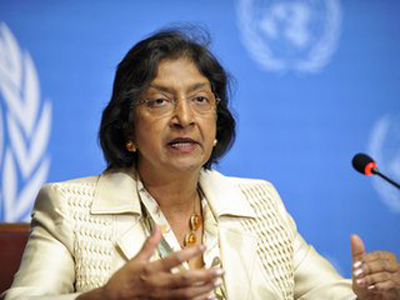
 AMMAN: More than 5,000 people have been killed in nine months of unrest in Syria, the UN human rights chief said, as an insurgency begins to overshadow what had been mostly peaceful protests against President Bashar al-Assad.
The latest figure reported to the UN Security Council by Navi Pillay is 1,000 higher than the one she announced just 10 days ago. The toll includes civilians, army defectors and those executed for refusing to shoot civilians, but not soldiers and other security personnel killed by opposition forces, she said.
The Syrian government has said more than 1,100 members of the army, police and security services have been killed.
Pillay said the Syrian government's actions could constitute crimes against humanity and issued a fresh call for the council to refer the situation to the International Criminal Court.
A wave of largely peaceful protests against four decades of Assad family rule erupted in Syria in mid-March, inspired by popular uprisings in Tunisia, Egypt, Yemen and Libya.
A violent security crackdown failed to halt the unrest, which has turned bloodier in the last few months as defecting soldiers join armed civilians in fighting back in some areas.
One flashpoint region is the central province of Homs, where an explosion set a gas pipeline on fire on Monday, the second reported pipeline blast in the area in a week. "The fire lit the night sky," said a resident who gave his name as Abu Khalaf.
The explosion occurred near the restive town of Rastan, the scene in late September of one of the first battles between army defectors and security forces. The insurgents have since opted for hit-and-run attacks on patrols and security compounds.
Despite the spiralling violence, the Syrian authorities held local elections on Monday as part of what they say is a reform process, but Assad's critics described the voting as irrelevant.
Monday was also the second day of the opposition's "Strike for Dignity", but its success was hard to gauge in some cities where violence has kept many residents in their homes.
Though the strike has found support in protest strongholds around the country, it has not taken hold in central parts of the capital Damascus or the business hub of Aleppo.
TWENTY MORE DEAD
In Homs, activists said at least four civilians were killed by tank fire on Muslim districts, where the strike held and voting was largely boycotted.
The Local Coordination Committees, an activist organisation, said security forces killed another 16 people elsewhere in Syria, including in villages around Homs and in the northwestern province of Idlib on the border with Turkey.
Syria has barred most independent journalists, making it hard to assess conflicting accounts of events there.
In New York, Western envoys on the Security Council said Pillay's briefing on Monday was the most horrifying they had heard in recent times and termed it scandalous that the council, paralysed by opposition from Russia and China, had taken little action on Syria.
"Independent, credible and corroborated accounts demonstrate that these abuses have taken place as part of a widespread and systematic attack on civilians," Pillay said, according to briefing notes seen by Reuters.
Russian Ambassador Vitaly Churkin said he too was troubled by Pillay's report but said outside intervention could lead to civil war and a far higher death toll.
Syrian Ambassador Bashar Ja'afari said Pillay should never have appeared before the council for a session that was part of a "huge conspiracy concocted against Syria from the beginning."
Assad's government portrays the municipal polls as part of a process leading to a parliamentary election next year and constitutional reform. But critics say local elections have little meaning in a country where power is highly centralised.
Prime Minister Adel Safar urged voters to "stand together to save our country from the conspiracies against us" and SANA said Syrians had flocked to the polls in 9,849 voting centres.
"The cost will be more human lives I am afraid. But it is less costly than an armed uprising and the regime dragging the country into a Libya-type scenario," said Rima Fleihan, a member of the foreign-based opposition Syrian National Council.




















Comments
Comments are closed for this article.