


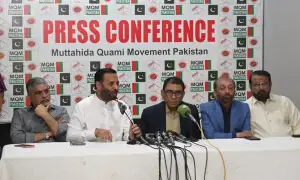
In the backdrop of mounting differences between the two principal coalition partners, the Muttahida Qaumi Movement's decision to part ways with the Pakistan People's Party at Centre was not entirely unexpected, but it was still stunning as it came.
The Gilani government may or may not fall consequent to the MQM's move - depending how others in the parliament react - but the latter's departure from the coalition has certainly unleashed a welter of political uncertainty that in the present national situation will further aggravate the economic misery of the people. There is no quarrel with the MQM's decision to quit the federal cabinet and sit on the opposition benches, for as an elected political party it has every right to make independent decisions on various national issues.
In fact, there was a lot of criticism within the MQM's own circles, when it apparently wavered and was seen to be backtracking on its pronouncements. But its decision to sit in opposition in parliament and yet to vote on issue-to-issue basis, though a positive, is bound to add to the lingering confusion and uncertainty. In a functioning democracy, the opposition mostly opposes and proposes nothing. A less charitable comment could be that the MQM would like to enjoy the bounties of both the worlds. So one may ask: Is the MQM an opposition party?
In that a similar position has been taken by the Pakistan Muslim League (Nawaz) also, one would tend to say that political uncertainty is bound to spawn. Interestingly, perhaps intriguingly, the PML (N) leadership is much more equivocal on the question of sustaining the Gilani government. Quite often the party leadership indulges in dubious rhetoric - that while it would not derail the democratic process and not endorse a vote of no-confidence against the Gilani government, it would not support a corrupt dispensation which it believes the present one is.
Of course, it shares with the PPP a commonality of interest in jointly ruling in Punjab, and never tires of reminding the PPP of its shared struggle against the General Musharraf-headed military regime. Chaudhry Shujaat-led PML (Q) may be a little more forthcoming on the question of taking a clear stand in the National Assembly on the question of keeping Prime Minister Gilani in the chair, but its problem is the PML (Like-minded faction), which nurtures entirely an opposite worldview.
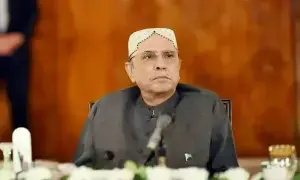
In fact, the only political party that has a clear-cut stand is the Jamiat Ulema-e-Islam (JUI-F), which wants Prime Minister Gilani to step down, and has called upon President Zardari to give the country a new prime minister. What makes the confusion worse confounded over the unpredictable future course of actions and events is the constitutional dictate and the parties' numerical strength in the National Assembly that elects the prime minister.
Given that the opposition is extremely divided and its component parties' leadership are suspicious of each other, there is almost a nil possibility of discovering a consensus candidate to replace the present incumbent. Even when Chaudhry Nisar Ali is the leader of opposition in the National Assembly and should be considered as the prime minister-in-waiting, you don't see that halo around his head.
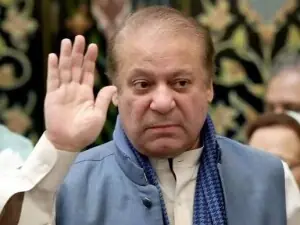
For the main opposition party, PML (N), Nawaz Sharif is the prime minister-in-waiting. But Nawaz Sharif is not a member of the National Assembly. In fact, much more than the numbers game it is the less than perfect constitutional provision dealing with the present crisis that tends to breed uncertainty. Now that Prime Minister Gilani's government is significantly short of majority, there are three possible courses of action.
One, President Zardari should ask Yousuf Raza Gilani to seek a vote of confidence from the National Assembly; which is not likely as already declared by Law Minister Babar Awan. Two, the opposition should pass a vote of no-confidence against Prime Minister Gilani, but here the problem is that the required 20 percent of the total membership of the National Assembly, which is 69, to move the resolution is apparently hard to come by unless MQM and PML (Q) join hands or the PML (N) moves it. So far there is no indication that such a number is ready to undertake this responsibility. Three, Prime Minister Gilani will continue to head a minority government.
When Prime Minister Gilani insisted he would continue despite all the desertions, he was in fact hinting at this third possibility. But that means more confusion and deepening crisis and uncertainty; leave alone the question of its ethical and moral justification. And this can linger on till about the time the National Assembly is asked to pass the Annual Budget, which a minority government cannot pass.
The country cannot endure another four to five months of extreme political uncertainty, with people's cup of patience already brimming with problems of double-digit inflation, worsening law and order situation and an extremely dangerous situation on the western border. The crisis besetting the country is too enormous to be held hostage to the power struggle between contending parties.
Before it explodes with dangerous and undemocratic implications, the higher political leadership have to sit and find a way out of this impasse. Politics is a game of the possible, and the leaders must prove that's right. Possibly, formation of a national government for the remaining part of the parliamentary term is a way out of it. Or, let the country have a snap election. The truth is there is no alternative to finding an urgent exit from the presently deepening uncertainty.













Comments
Comments are closed for this article.