


In an exclusive interview, the first ever with any national daily, Edward W. Birgells, (Regional Director Khyber Pakhtunkhwa/FATA for US Agency for International Development) and Shakeel Qadir (Secretary, Provincial Reconstruction, Rehabilitation and Settlement Authority (PRRSA) and Provincial Disaster Management Authority (PDMA), Khyber Pakhtunkhwa) told Business Recorder's team comprising staff reporters Wasim Iqbal and Qamar-uz-Zaman that more time will be required for project completion in KP than envisaged due to security concerns.
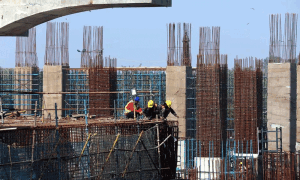
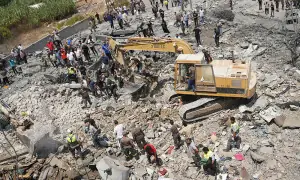
Both officials agreed that it could take an additional two years to clear the aftermath of the military operation coupled with floods in Malakand, Bajaur and Mohmand Agencies. According to him, USAID is targeting to allocate $142 million on reconstruction and rehabilitation of Swat and other districts of KP adversely affected by the war against terror and the devastating floods.
The following are excerpts from the interview:
Business Recorder: Why is KP the main focus of attention?
Edward W. Birgells: Development will provide the people of the region an opportunity to oppose militancy and extremism, and re-visit their approach to challenge the writ of the state. USAID has been engaged in over 1200 community programmes in FATA and is continuing this support. Our approach now is to do bigger programs for FATA similar to Malakand.
Shakeel Qadir Khan: Poverty levels in KP have peaked at 42 percent, which is 5-7 percent higher than the national figure. The entire province has been adversely affected by militancy due to which their standard of life has gone down. PARRSA has completed a detailed survey of the damage and has identified 21,000 houses destroyed in Swat and other parts of Malakand. The second phase of paying compensation is underway and 6,000 households have been paid the amount.
Business Recorder: : Is your development work contingent on the presence of the Pak army?
Edward W. Birgells: Security does impact on implementation. It is a fact that without the presence of Pak army we could not have implemented our projects in the region. Security in the region is unpredictable and sometimes we are unable to work in an area where we had spent several weeks.
Business Recorder: : How many projects are underway in South Waziristan?
Edward W. Birgells: Development projects worth $135 million have been planned for South Waziristan. Out of this total, $100 million would be spent on roads and another $35 million on electricity projects. In addition, we are financing FATA Secretariat, and supporting the construction of Gomal Zam Dam as well as the transmission line from the Dam to Wana District.
Business Recorder: : What has been earmarked for resettlement of Internally Displaced Persons (IDPs)?
Edward W. Birgells: The US government spent over $400 million for IDPs of Malakand during the military operation in 2009. This amount was disbursed through local NGOs and government channels on food and repatriation.
Business Recorder: : Has transparency been a focal point in spending these funds?
Edward W. Birgells: Transparency is observed by both PARRSA and USAID in spending and all the projects have been regularly supervised.
Business Recorder: : What are the estimates of damage due to military operation and floods in Bajaur and Malakand agencies in particular and the region in general?
Shakeel Qadir Khan: According to provincial data, 21,000 households were identified for damage compensation. The US government has provided $65 million as damage compensation to provincial administration. Currently, federal government is in the process of transferring these funds to provincial accounts.
Edward W. Birgells: USAID has provided $36 million for reconstruction of damaged schools, hospitals and other infrastructure in the civic sector. In this respect, $20 million is earmarked to be spent on education, 12 million on health, $3 million on drinking water and sanitation and $1 million is to be spent on capacity of the departments.
Business Recorder: : Is USAID assistance channelled through government's executing agencies?
Shakeel Qadir Khan: Out of a total of $142 million, an amount of $101 million comes through government account and the rest, $41 million, will be directly spent by USAID through its own contractors. PRRSA has so far received $70 million. Revitalisation project is being implemented directly through USAID's own contractors and services and $21 million has been earmarked for free distribution of seeds and fertiliser to farmers whose crops were washed away in the summer floods.
Business Recorder: : What kind of security concern provincial government has shown and its solution?
Shakeel Qadir Khan: Security is a major concern of the provincial government. It does not only affect the life of people in those particular areas but project completion takes a lot longer than scheduled. We have different models and approaches to achieve the desired result. In Swat District and in FATA, provincial government and USAID have utilised the capacity of Pak army in rebuilding 250 schools. Its result was very successful.
Edward W. Birgells: USAID also acquired the services of Frontier Works Organisation (FWO) through FATA Secretariat to construct roads as the civilian model cannot be apply there because of serious security concerns.
Business Recorder: : How much time is required to complete reconstruction and rehabilitation in areas destroyed during the war against terror?
Shakeel Qadir Khan: Construction and rehabilitation phase could take another two years in Malakand, Bajaur and Mohmand Agencies due to harsh weather, security concerns and other ground realities. Things do not move as swiftly as one would hope. We have been directed to complete projects in 18 months, however, due to security concerns it may well take an additional six months.












Comments
Comments are closed for this article.