



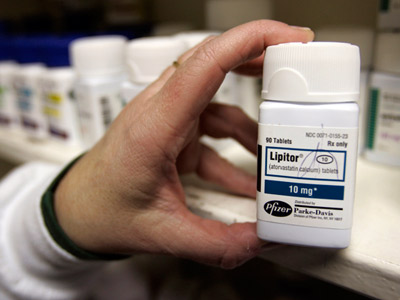
 NEW YORK: Pfizer's patent on the best-selling drug of all-time, the cholesterol-lowering medication Lipitor, expired on Wednesday, opening the path to generic competitors for America's most popular medication.
Lipitor came on the market in 1997, and has raked in some $100 billion for Pfizer even in a crowded market that includes various other cholesterol-lowering statins, many of which have already gone generic.
In the United States, anti-cholesterol drugs account for 255 million prescriptions a year, and about nine million people are taking Lipitor.
US-based Watson Pharmaceuticals immediately announced its launch of a generic version of Lipitor, atorvastatin calcium, under an exclusive supply and distribution agreement with Pfizer, whereby Pfizer manufactures the drug and Watson sells it, sharing net sales with Pfizer until 2016.
Indian-based Ranbaxy, which was also expected to release its generic in the next six months, still awaits the green light from US authorities due to delays over problems with quality control and some of their Indian factories.
"There should be a price war in that first six months," said Morningstar analyst Damien Conover.
As companies elbow for market share of the cheaper generic version of Lipitor, Pfizer is left hunting for new sources of revenue to replace the cash flow from its longtime star, which made up 15 percent of Pfizer's annual sales.
Pfizer has not released its projected losses due to the patent expiration, but its company forecasts call for sales in 2012 of $63-63.5 billion, versus $67.8 billion in 2010.
Lipitor global sales were over $10 billion last year, according to earnings reports. Conover estimated a sales figure of $3.8 billion in 2012.
Pfizer already lost exclusive rights on the product in Canada, Spain, Mexico and Brazil last year, but it continues to earn revenue in developing countries.
In the United States, Pfizer has not yet thrown in the towel, and is aiming to defend its territory and undercut its competitors in the generic market.
By forming alliances with pharmacies and health insurance companies, Pfizer will continue to offer Lipitor "at or below generic cost" during the next 180 days, company spokesman MacKay Jimeson told AFP in an email.
"In this 180-day period, typically payers do not receive a significant cost-savings by utilizing a generic," he added.
Lipitor currently costs about $120 per month, a price that should drop 30 percent in December, slightly more than the typical 10-20 percent that a drug price typically falls after a patent expires.
Pfizer has made a deal with Diplomat Specialty Pharmacy in the northern state of Michigan to create the program "Lipitor For You," so customers can sign up online to continue to get the drug in their pharmacy or home-delivered.
It is too early to know if this approach will continue beyond six months. Pfizer could decide to continue to compete with other generic makers but it would have to lower prices even more, which may not prove profitable.
Pfizer is counting on licensing deals that will continue to generate revenue from Lipitor, such as one signed with the French pharmaceutical giant Sanofi-Aventis which will make and market its generic version in France starting in May 2012.
"I don't think they'll be able in short term to compensate, but they have a lot of products in pipeline," said Conover, referring to Pfizer.
Among them are an anti-clotting drug known as Eliquis, and another against rheumatoid arthritis known as tofacitinib, which together could make up a billion dollars in annual sales.
Ratings agency Standard and Poor's said it views the New York-based drug giant as well-placed to survive the expiration of the patent on Lipitor.
"Over the next two years, the company will be able to weather the upcoming storm of patent expirations and associated revenue loss while maintaining its excellent business risk profile and a solidly minimal financial risk profile."
A two-year study released earlier this month showed that maximum doses of Lipitor and its competitor Crestor, made by AstraZeneca, were similarly effective and safe in cutting down plaque in the arteries.
Side effects may include liver and muscle problems.
With Lipitor going generic, Crestor will be left as the sole major brand-name statin on the market.
"The market for Crestor will go close to zero," said Cam Patterson, chief of cardiology at the University of North Carolina-Chapel Hill.




















Comments
Comments are closed for this article.