



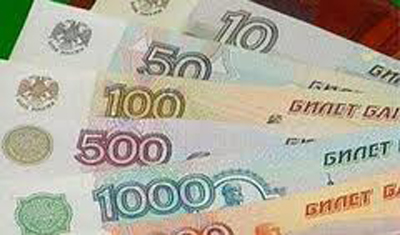
 LONDON: Oil producers Russia and Kazakhstan led emerging currency gains on Monday thanks to relatively stable oil prices although EM stocks edged lower, with China and most other Asian markets closed for Lunar New Year.
The Russian rouble opened 1 percent higher and the Kazakh tenge firmed 1.8 percent after Brent crude futures rallied to over $34 a barrel in early trading on continued speculation about a co-ordinated cut in production.
But by 1000 GMT the rouble stood just 0.5 percent firmer versus the dollar. Tatiana Orlova, senior Russia/CIS economist at Royal Bank of Scotland said the currencies would continue to track oil price moves. She noted that rouble bond yields had failed to react much to Friday data showing inflation falling below 10 percent.
"On the one hand there is a broadly positive story on (Russian) inflation which should drop into single digits, but if there is another drop in oil prices the positive story will be overshadowed by another plunge in rouble," Orlova added.
Middle Eastern bourses also benefited with Saudi Arabia up 1.2 percent at one point and Dubai up 2.8 percent. But the benchmark emerging equity index slipped 0.4 percent in lacklustre trading as China and many other Asian bourses were closed for public holidays.
Over the weekend China reported a $100 billion fall in its foreign exchange reserves in January to the lowest level since May 2012.
The central bank has been using dollars to defend the yuan.
Indian stocks slid 0.9 percent ahead of fourth quarter economic growth data expected to come in around 7.3 percent, ahead of China's 6.8 percent.
The Turkish lira also weakened against the dollar despite industrial production rising 4.5 percent year-on-year in December, more than expected.
"The data are volatile, but the underlying trend is one of strong growth," said William Jackson, senior emerging markets economist at Capital Economics.
"Overall, it looks like GDP may have expanded by around 4 percent year-on-year."
Argentina's 2033 dollar-denominated Eurobond firmed 0.25 percent after the country offered a $6.5 billion cash payment to holdout creditors on Friday. If accepted this would represent a roughly 25 percent discount on what creditors claim.
The yield premium for Argentine sovereign bonds over US Treasuries fell to a one-month low of 472 basis points following the news.
Azerbaijan's 2024 dollar bond was slightly firmer on the day, although Moody's on Friday became the second ratings agency to cut its credit rating to junk.
"Azeri spreads have widened enormously in the past three months so the downgrade at this point doesn't matter too much," said Orlova.
"The market has already priced in the negative."
Egyptian non-deliverable forwards (NDF) continued to price in expectations of a weaker pound after government sources revealed Egypt was preparing a budget for 2016-17 based on 8.25 Egyptian pounds per dollar.
The budget for the current fiscal year assumed an exchange rate of 7.75 pounds.
In the six-month NDF market, the exchange rate was at around 9.3 per dollar.
Ukrainian dollar bonds slipped between 1.2 and 1.8 percent across the curve as fears continued to mount over the fate of the ruling coalition following last week's ministerial resignations.


























Comments
Comments are closed for this article.