


BoJ to stand pat but wary of yen spike

Normal 0 false false false MicrosoftInternetExplorer4
st1\:*{behavior:url(#ieooui) }
/* Style Definitions */
table.MsoNormalTable
{mso-style-name:"Table Normal";
mso-tstyle-rowband-size:0;
mso-tstyle-colband-size:0;
mso-style-noshow:yes;
mso-style-parent:"";
mso-padding-alt:0in 5.4pt 0in 5.4pt;
mso-para-margin:0in;
mso-para-margin-bottom:.0001pt;
mso-pagination:widow-orphan;
font-size:10.0pt;
font-family:"Times New Roman";
mso-ansi-language:#0400;
mso-fareast-language:#0400;
mso-bidi-language:#0400;}
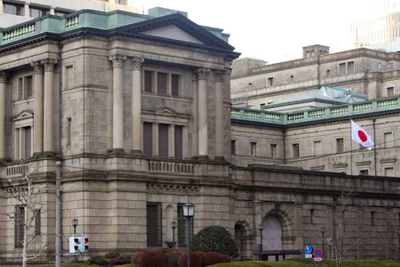 TOKYO: The Bank of Japan is expected to refrain from easing monetary policy this week, with the yen's retreat from its record high and a resilient stock market allowing it to save for later its limited options to support the fragile economy.
But the central bank has not let its guard down and could choose to ease policy for a second straight meeting if US recession fears push the dollar well below its record low hit last month and trigger a stock market sell-off.
Otherwise, the BoJ prefers to hold fire until October and wait for more clues on whether risks have heightened enough to alter its forecast that the world's third-largest economy will resume moderate growth this autumn after being tipped into recession by the effects of the March 11 earthquake and tsunami and the subsequent nuclear crisis.
Here are possible outcomes from the two-day meeting ending on Wednesday:
The BoJ is sticking to its recovery scenario but feels that the global slowdown and stubbornly strong yen have heightened the risk of Japan's economy undershooting its forecast, with the fallout already showing in domestic factory output.
Still, it feels it has acted against such risks with last month's easing, and prefers to stand pat if markets stay calm.
The BoJ sees plenty of reasons to save its depleted policy arsenal for now. The Federal Reserve has signalled an expanding of monetary stimulus in September, which could drive up the yen again and hurt Japan's exports, already slowing from soft global demand.
Political pressure for action by Japan's central bank may also heighten next month, when debate on how to foot the bill for post-quake reconstruction starts in earnest under Japan's new premier Yoshihiko Noda.
All this makes it more likely the BoJ will consider easing policy in October rather than now.
MARKET REACTION: Markets will not react much unless Governor Masaaki Shirakawa signals a strong chance of monetary easing next month in his post-meeting news conference on Wednesday.
EASE POLICY BY BOOSTING ASSET PURCHASES
POSSIBILITY: LESS LIKELY
Some central bankers have doubts whether Japan's economy will resume a recovery in the autumn, worried that the global slowdown may be more serious than initially thought. Friday's dismal US payrolls data may have reinforced such concerns.
The government has already signalled that it wants the BoJ to do more as it maps out steps to help companies counter the strong yen. Motohisa Furukawa, economics minister in the new cabinet formed last Friday, says he wants the BoJ to consider easing policy further.
The BoJ is thus determined to quickly counter any adverse market moves that threaten the economy. That means it may act if concern over the US economic outlook pushes the yen well beyond the record 75.94 yen to the dollar hit last month.
Still, it would take a very sharp rise in the yen accompanied by a tumble in Tokyo share prices for the BoJ to act now.
If the central bank were to ease policy it would likely boost its asset buying scheme -- which was topped up just last month -- by another 5 trillion yen ($65 billion), with most of the increase in government bonds and exchange-traded funds.
MARKET REACTION: Bond yields and the yen might fall while share prices rose, although the impact would be short-lived.
REVERT TO FULL-BLOWN QUANTITATIVE EASING
POSSIBILITY: HIGHLY UNLIKELY
The central bank regards the asset buying scheme, targeting government bonds and a range of private debt, as its key monetary policy tool. But it can probably only top it up once or twice, given limits to how much more risk assets it can buy without hurting its balance sheet.
This is not an immediate possibility but is rather an option that may emerge later this year if Japan experiences a severe economic downturn.





















Comments
Comments are closed for this article.