


Japan PM Kan expected to announce resignation

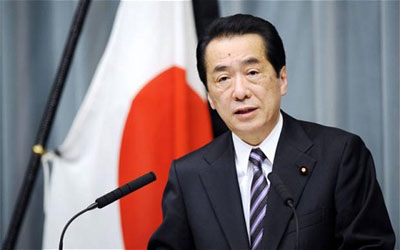 TOKYO: Embattled Japanese Prime Minister Naoto Kan was expected to announce his resignation Friday, paving the way for the nation's sixth premier in five years to steer a recovery from the March disasters.
Kan's resignation was expected almost six months since the devastating March 11 quake, tsunami and ensuing nuclear disaster sorely tested his leadership, and prompted accusations he mishandled the crisis.
After surviving a no-confidence vote in June, Kan said he would quit on the condition that three key bills were passed -- a second budget, a budget financing bill and legislation promoting the use of renewable energy.
The final two bills were passed on Friday.
Kan is expected to officially step down from his party and government posts when the ruling Democratic Party of Japan (DPJ) elects a new party president, which Chief Cabinet Secretary Yukio Edano said would take place Monday.
Parliament would then vote the leader in as premier on Tuesday next week.
Up to nine candidates could end up jockeying to succeed Kan, including the favourite, former Foreign Minister Seiji Maehara. Finance Minister Yoshihiko Noda may also file for candidacy when campaigning begins on Saturday.
Whoever wins faces the unenviable tasks of overseeing Japan's biggest post-war reconstruction, the resolution of the world's worst nuclear crisis since Chernobyl 25 years ago and shielding the economy from a soaring yen.
They must also unite a divided parliament and win market confidence that Japan can overcome a legislative quagmire to address the world's biggest debt.
Ratings agency Moody's this week downgraded Japan, citing its revolving-door political leadership as a major obstacle to much needed reform.
"The latest power change will yet again give the world the impression that Japan's leadership is fickle," said Shinichi Nishikawa, professor of politics at Meiji University in Tokyo, adding that Kan's replacement must hold power for longer.
Maehara, 49, who stepped down as Foreign Minister in March over a donation row, could become Japan's youngest post-war Prime Minister. He has advocated the pursuit of growth instead of raising taxes to ease Japan's fiscal woes.
Noda -- who recently gave statements supporting war criminals -- has softened his earlier stance on hiking taxes.
Between candidates such as Maehara and the premiership stands party kingmaker Ichiro Ozawa, who controls the DPJ's biggest political faction.
Ozawa, a divisive figure who faces criminal trial over a donations scandal, leads a group of roughly 130 lawmakers out of the 398 who can vote on Kan's replacement.
After taking office in June last year, the 64-year-old Kan struggled amid low support ratings, a power struggle within the DPJ and a divided parliament in which the Liberal Democratic Party opposition blocked various bills.
The deadlock characterised Kan's tenure and helped erode high early expectations of him as the first leader in years not born into a political dynasty, as the DPJ failed to meet its election pledges.
Japan's triple disaster -- which left 20,000 dead or missing, wiped out towns and sparked the Fukushima nuclear accident -- arguably gave Kan another lease of life.
But to the dismay of voters, a short-lived political truce gave way to renewed bickering and infighting within about a month.
Charges that Kan had bungled the response to the calamity, as authorities delayed admitting that the nuclear crisis was worse than initially thought, quickly grew louder.
The lame-duck leader advocated a nuclear-free future for Japan in defiance of the power companies, bureaucrats and politicians who make up Japan's so-called "nuclear village", making more enemies along the way.
The message tapped into popular sentiment, with some polls saying 70 percent of Japanese want to phase out atomic power, but was not enough to revive his own tumbling ratings.
Copyright AFP (Agence France-Presse), 2011






















Comments
Comments are closed for this article.