


Libya unlikely model for Arab revolts

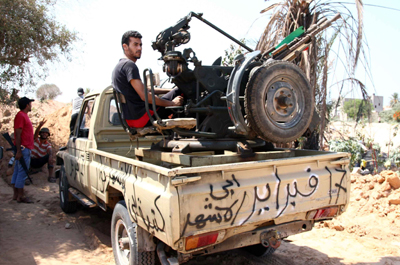 DUBAI: The anti-Qadhafi revolution in Libya may serve as an inspiration but is unlikely to be copied in the Arab world with its armed revolt and foreign military intervention, analysts say.
Libyan leader Moamer Qadhafi, who came to power 42 years ago in a military coup, looks poised to become the third Arab ruler to be swept aside by this year's "Arab Spring."
But while presidents Zine el Abidine Ben Ali of Tunisia and Egypt's Hosni Mubarak were toppled in peaceful demonstrations which lasted just weeks, the NATO-backed rebels in Libya needed six months to bring Qadhafi to the brink.
"I think to see another Arab ruler fall will encourage other opposition movements in the Arab world," said Jane Kinninmont a specialist on the Arab world at Chatham House in London.
"Maybe by the end of 2011 we would have the fall of five Arab leaders," she said, suggesting Syrian President Bashar al-Assad and his Yemeni counterpart Ali Abdullah Saleh could follow.
"But I think Algeria is the country that is the most concerned, because of its geographical proximity" to Libya, Kinninmont said.
"Morocco has responded by announcing some quite far-reaching reforms, while Algeria has been successful in repressing protests and doesn't seem able to carry out political reform," she said.
Salam Kawakibi, research director at the Arab Reform Initiative, agreed the rebels' capture of Tripoli would "give hope to Arab revolutions, after the frustrations of recent months."
Syria's crackdown on anti-regime protests since March has left more than 2,200 dead, while Yemen's Saleh who is recovering from bomb-blast wounds in Saudi Arabia has announced he plans to return soon.
Kawakibi regretted that "the Libyan rebels arrived at their victory with foreign help," stressing that pro-democracy demonstrators in Syria and Yemen wanted to keep their protests unarmed and avoid foreign intervention.
Ibrahim Sharqieh Ibrahim, deputy head of the Brookings Doha Center, agreed.
revolution," but the Paris-based analyst was also wary of foreign interference in Libya.
"The countries that intervened militarily in Libya, citing humanitarian reasons, had an eye on the markets that will open and on reconstruction" of the oil-rich country, he said.
Libya's crude reserves of 44 billion barrels are Africa's largest, and particularly attractive because of the oil's low sulphur content and the country's geographical proximity to Europe.
"I fear that following the liberation of Libya, in addition to the inevitable economic price, there is a political price to pay: the country has grown very close to Western policy," said Kawakibi.
Copyright AFP (Agence France-Presse), 2011

















Comments
Comments are closed for this article.