


Macedonia still fragile ten years after conflict

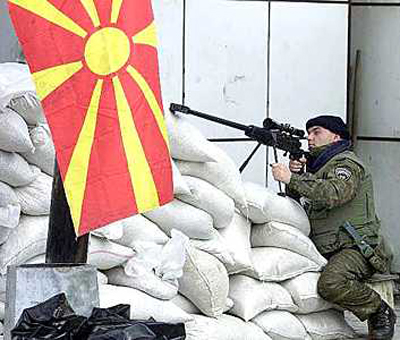 SKOPJE: Ten years after the Ohrid agreement that brought Macedonia back from the brink of all-out civil war the tiny Balkans country is stable but some warn an ongoing name row with Greece slows down reconciliation.
"Ten years after signature of the Ohrid Framework Agreement that ended fighting between the country's ethnic Albanians and Macedonians, much of the agreement has been implemented, and a resumption of armed conflict is unlikely," the International Crisis Group think tank said in a report published on the eve of the anniversary Saturday.
However it warns that the country remained "fragile" and that the "inability to solve the name dispute with Greece and the consequent failure to make progress towards NATO and EU integration, exacerbates tensions between ethnic Albanians and Macedonians and the government and the opposition".
When the Ohrid agreement was signed on August 13, 2001, it ended a six month conflict between the Macedonian security forces and independence seeking ethnic Albanian rebels. Central to the deal were a string of reforms that gave ethnic Albanians, who make up some 25 percent of Macedonia's population of two million, more rights and include them more in society.
From that stand-point the agreement was a success, said Musa Xhaferi, the current Macedonian deputy prime minister and a former key political figure of the ethnic Albanian rebel movement.
"The agreement brought back the peace in Macedonia and to a large extent it has restored people's trust in the (state) institutions," he told AFP.
However he added that the ongoing name row with Greece has "cost us a lot".
Athens has blocked Skopje's entry into NATO and the European Union as a result of the almost two-decades long dispute.
The two countries have been at loggerheads since Macedonia proclaimed independence from the former Yugoslavia in 1991, with Greece insisting that the use of the name Macedonia implies a claim on Greek territory. UN-led negotiations have so far been fruitless.
"We do have to find a solution that will not harm Macedonia and invest all as much energy as possible to find a compromise for the (EU and NATO) perspective to be open," Xhaferi stressed.
Vladimir Misev, a political analyst from the Macedonian Institute for Democracy, told AFP that Ohrid brought "harmonisation and peaceful development."
"The results show that this is achieved and the state administration now employs over 20 percent ethnic Albanians," he said to illustrate the inclusion of the ethic Albanians.
On the name issue, Misev added that with Athens' current financial trouble it seems to have been pushed to the background.
Copyright AFP (Agence France-Presse), 2011
Copyright APP (Associated Press of Pakistan), 2011






















Comments
Comments are closed for this article.