



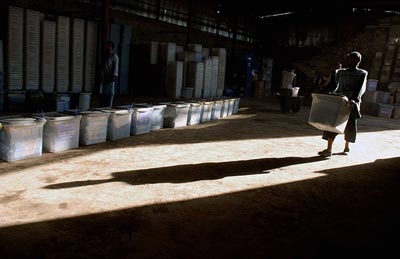
 KABUL: President Hamid Karzai on Wednesday handed authority for resolving a lingering dispute over last year's fraud-hit Afghan parliamentary elections to the Independent Election Commission (IEC).
Although some observers hoped Karzai's decree could be a step towards breaking the paralysis dogging the Afghan parliament since its inauguration in January, it also raised fresh questions about how the row would be resolved.
The IEC will now be responsible for deciding how many Afghan lawmakers should be disqualified from parliament because of vote-rigging in the September 2010 polls.
The question is highly sensitive in Afghanistan and has prompted angry protests on the streets of Kabul by both winning and losing lawmakers.
It has also raised fresh questions about Karzai's own standing, with some experts accusing him of dragging out the dispute in order to neuter opponents in parliament.
The decree said the IEC should "immediately finalise" the issue and added: "After this decree, all issues of the Wolesi Jirga (parliamentary) elections processed in any other body, apart from the IEC, are considered ended."
It dissolved Afghanistan's special election tribunal -- which Karzai had backed -- and disqualified other government bodies from ruling on the issue, which is being eagerly watched by diplomats in Kabul.
The IEC had certified the original election results last November but will now have to issue a fresh ruling, following months of controversy.
But an official in Karzai's office, speaking anonymously because he was not authorised to speak to the media, explained that the IEC would have to base its findings on previous court rulings.
"The president is asking the IEC to make a final decision based on the evidence, findings and verdicts of the special court and the appeal court," the source told AFP.
In June, the special tribunal ruled in favour of throwing out 62 lawmakers, a quarter of the 249-seat lower house of parliament, known as the Wolesi Jirga.
While welcoming the decree, an IEC spokesman insisted it did not oblige the IEC to respect the special tribunal's ruling on throwing out 62 lawmakers, which it strongly opposed.
"We believe that it (the decree) opens new doors to resolving all the disputes over the parliamentary election," spokesman Tabesh Forogh told AFP.
"The decree recognises the IEC as the only body authorised to address all election-related issues."
But when asked whether it would abide by the special tribunal's previous ruling, he said: "The decree does not oblige us to do anything."
The presidential decree was also welcomed by one losing candidate who would return to parliament if the special tribunal's ruling on kicking out 62 lawmakers was implemented.
Daud Sultanzoi told AFP: "We welcome any action that is taken to institutionalise the rule of law in this country."
Copyright AFP (Agence France-Presse), 2011




















Comments
Comments are closed for this article.