



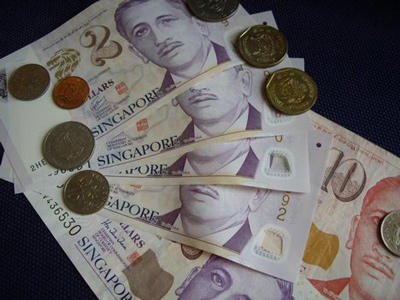
 SINGAPORE: Most Asian currencies fell on Tuesday, with the Singapore dollar extending its losses after the city-state reported a year-on-year drop in headline inflation for the first time in nearly five years in November.
Singapore's all-items consumer price index (CPI) fell 0.3 percent in November from a year earlier, the first annual decline since December 2009.
Economists said the CPI data by itself is unlikely to prompt the Monetary Authority of Singapore (MAS) to ease monetary policy at its next policy review in April, given that the year-on-year fall in CPI was not caused by any sharp drop-off in demand.
Still, traders said it was enough to dent the Singapore dollar, which added to its earlier losses and touched a low of 1.3239 versus the US dollar at one point. That brought it close to an early December trough of 1.3245, the Singapore dollar's lowest level since November 2010.
In Singapore, headline inflation has declined this year due to falls in rent following property-cooling measures in recent years, as well as a drop in the prices of car permits. Both elements can be heavily impacted by government policies.
The data is not "alarming enough" for the MAS to be forced into any knee-jerk type of policy reaction, said Vishnu Varathan, senior economist for Mizuho Bank in Singapore.
However, Varathan added that the chances of the MAS easing policy in 2015 are increasing. He said his expectation is for an easing in October - at the second of two semi-annual policy reviews - by reducing the upward slope of the Singapore dollar's policy band.
With Singapore's growth likely to remain modest next year and as weak oil prices bring disinflationary pressures, there is a minority view among economists that the MAS will ease monetary policy in April.
At its last policy review in October, the MAS stuck to its tight monetary policy stance of allowing a "modest and gradual" appreciation of the Singapore dollar and kept the slope, width and mid-point of the Singapore dollar's policy band unchanged.
The relative firmness of core inflation, which excludes changes in car-related and accommodation costs and is the focus of monetary policy, is one reason why many economists have been sceptical the MAS would ease policy very soon.
In November, core inflation slipped to a 19-month low of 1.5 percent year-on-year but is still averaging close to 2.0 percent for the whole of 2014, in line with the central bank's 2-2.5 percent forecast for this year.

























Comments
Comments are closed for this article.