



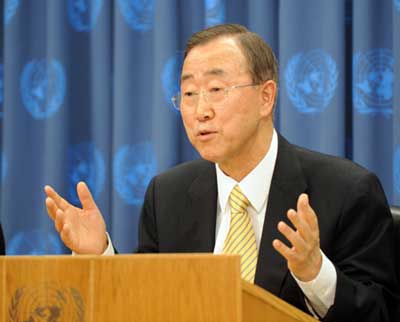
 UNITED NATIONS: UN Secretary-General Ban Ki-moon on Friday made an impassioned plea to the international community to mobilize resources to avert a humanitarian catastrophe in Somalia, where severe drought has plunged communities in the southern region of the country into famine.
"To save the lives of the people at risk - the vast majority of them women and children - we need approximately $1.6 billion in aid," said Ban in an op-ed published in the Los Angeles Times.
"So far, international donors have given only half that amount. To turn the tide, to offer hope in the name of our common humanity, we must mobilize worldwide. This means everyone. I appeal to all nations - both those who fund our work year-in and year-out, and those who do not traditionally give through the multinational system - to step up to the challenge," said the Secretary-General.
He noted that UN agencies would on Monday gather in Rome to coordinate the emergency response for Somalia and raise funds for immediate relief. Ban also emphasized the need to find ways to deal with vulnerabilities brought on by recurring droughts in the Horn of Africa.
"Today's drought may be the worst in decades. But with the effects of climate change being increasingly felt throughout the world, it will surely not be the last. This means practical measures - drought-resistant seeds, irrigation, rural infrastructure, livestock programmes - to boost agricultural production," the Secretary-General wrote.
He said early warning systems have improved, noting that the current drought was forecast as early as last November. "Looking ahead, we must ensure those warnings are heard in time," he said.
Ban called for an end to conflict in Somalia, saying the unrest was exacerbating the consequences of the drought. "As long as there is conflict in Somalia, we cannot effectively fight famine. More and more children will go hungry; more and more people will needlessly die. And this cycle of insecurity is growing dangerously wide," he wrote.
Meanwhile, the UN High Commissioner for Refugees (UNHCR) reported that an average of 1,000 desperate people are arriving in the Somali capital, Mogadishu, every day seeking help after fleeing famine-stricken regions in the south. "Our latest figures show that in July alone, more than 20,000 people have been displaced into Mogadishu in search of assistance," UNHCR spokesperson Melissa Fleming told reporters in Geneva.
Half that number came from the Lower Shabelle, one of the regions where famine was declared on Wednesday. Another 2,800 originated from the southern area of the Bakool, which is also facing famine, while the rest came from the Bay and Middle Shabelle regions.
On Wednesday, UNHCR handed out emergency assistance packages to an estimated 15,000 internally displaced persons (IDPs) in the Dharkenley district of southwest Mogadishu, she said. Each package of the 2,500 packages contained a tarpaulin, three blankets, a sleeping mat, two jerry cans, a full kitchen set and utensils.
UNHCR plans to distribute an additional 7,500 packages in the coming weeks. Somalis hard hit by the severe food shortages in their country have also been arriving in large numbers in refugee camps in Kenya and Ethiopia. An estimated 100,000 refugees from Somalia have arrived in camps in Kenya's Dadaab area so far this year, while another 78,000 have gone into camps in the Ethiopia's Dollo Ado border area.
On Tuesday, some 15 people died as a result of malnutrition and related diseases in the Kobe camp in Ethiopia, having arrived too sick to be saved, according to Ms. Fleming. UNHCR staff in Dadaab, Kenya, have also reported that deaths related to acute malnutrition, particularly among children, are on the rise.
Copyright APP (Associated Press of Pakistan), 2011























Comments
Comments are closed for this article.