



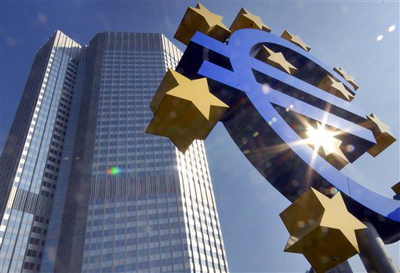
 LONDON: Low-rated euro zone bond yields fell on Tuesday after several sources told Reuters the ECB was considering buying corporate bonds, quelling some concerns that the central bank was not doing enough to stoke inflation and growth.
The report also prompted investors to pull out of safe haven German bonds, where they had sought refuge after a series of weak growth data - the latest of which came from China on Monday - dragged on the global economic outlook.
"Investors now appear to take a little bit more risk on the basis that there is a relief that the ECB is considering doing something else," said Lyn Graham-Taylor, a rates strategist at Rabobank.
To complement the ECB's covered bond and asset-purchase programme that started this week, the ECB is mulling whether to begin buying corporate bonds. It may decide on the matter as soon as December, sources told Reuters.
German 10-year yields rose 4 basis points after the Reuters report, reversing earlier falls and hitting a high for the day of 0.89 percent.
In contrast, Portuguese yields, which had risen by as much as 10 bps in early trading, were 4 bps lower on the day at 3.48 pct. Italian equivalents were 7 bps lower at 2.51 pct, while Spain's were 3bps lower at 2.23 pct.
Greek yields - pressured by the government's bid to exit its bailout and the threat of early elections - were 25 bps lower at 7.81 pct, having earlier climbed as high as 8.17 pct.
Irish yields were the exception - still some 3 bps up on the day at 1.90 percent. Dealers said expectations of a forthcoming 15-year bond sale were weighing on the market.
Some strategists said that while the new programme was supportive for low-rated bonds, it could push back expectations of a sovereign bond-buying quantitative easing (QE) programme.
"The story may suggest government bond buying is not that close on the agenda from the ECB compared to elevated market expectations," said Rainer Guntermann, a strategist at Commerzbank.
DZ Bank strategist Christian Lenk added: "It certainly gives risky assets a little bit of help and puts Bunds under pressure as the ECB might not focus on government bonds but on corporate bonds instead to fulfil the balance sheet expansion that it has announced."
But with Germany's central bank warning on Monday that the country risks coming dangerously close to recession, any further ECB intervention will bring relief.
The bloc's largest economies are at loggerheads on how to boost growth. Countries including Italy and France have called for more fiscal flexibility in the euro zone, while Germany is eager to keep public finances in check.
Italy's draft budget which it submitted last week, and which proposed slower cuts to its deficit, looks set to be rejected by the European Commission.
Germany and France promised on Monday to unveil joint proposals on strengthening investment and competitiveness by early December.




















Comments
Comments are closed for this article.