


Sudan to launch new currency

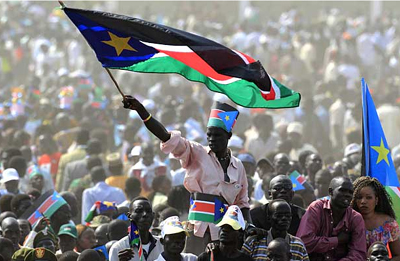 KHARTOUM: Sudan will launch a new currency as part of a package of emergency economic measures, President Omar al-Bashir announced Tuesday, as Khartoum struggles to cope with soaring inflation and an expected drop in oil revenues.
Addressing parliament just three days after the oil-producing south formally proclaimed independence from the north, Bashir said Sudan would have a new currency "in the coming days" as part of a three-year emergency programme.
He also said there would be changes to the budget but "without any increase in taxation."
With the secession of the south, where three-quarters of Sudan's oil was produced, Khartoum's total revenues are expected to drop by more than 36 percent, according to the country's finance minister.
Under the three-year economic programme announced last month, Sudan's cash-strapped government plans to cut spending and widen the tax base to try to offset the economic impact of southern secession.
South Sudan announced on Monday that it would launch its own currency after one week.
The Sudanese pound, the existing currency in north and south, replaced the dinar in 2007 after the signing of the peace accord two years earlier.
The pound has plunged in value over the past six months, mainly because of the surge in food prices and weak state finances.
US economic sanctions and the country's huge foreign debt, estimated at around $38 billion (27.2 billion euros), have choked the government's access to external loans.
In his speech to parliament, Bashir also vowed to bring political stability and development to the state's of Blue Nile and South Kordofan, where fighting between government troops and Nuba militia aligned to the ex-rebel army of the south is ongoing, according to the United Nations.
"I assure the people of Blue Nile and South Kordofan that we're going to concentrate on the development of these areas."
"We are going to ... extend the timetable of the popular consultations, to give the people of Blue Nile and South Kordofan more time to reach political stability."
Under the 2005 peace accord, the residents of the two states were supposed to have the chance, prior to southern secession, to express publicly how well they believed the agreement was implemented, in so-called popular consultations.
The UN humanitarian office (OCHA) on Tuesday reported heavy bombardments and gunfire has taken place in different areas of South Kordofan, including around the state capital Kadugli, over the past week, dimming the prospects of any imminent political settlement there.
The United Nations says the fighting in the ethnically divided state has displaced more than 70,000 people, but reliable figures are virtually impossible to come by, given the tight restrictions on the movement of UN agencies and NGOs.
The World Food Programme has been prevented from bringing emergency food aid into the state, OCHA said in its latest report, with four WFP trucks travelling to the town of Deleng turned back by local authorities on security grounds.
Copyright AFP (Agence France-Presse), 2011







Comments
Comments are closed for this article.