



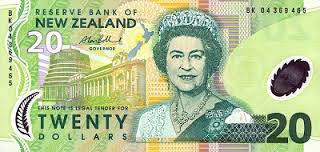
 WELLINGTON/SYDNEY: The New Zealand dollar slipped to six-month lows against its broadly stronger US counterpart on Monday, while the Australian dollar shot up to multi-month highs versus the euro and yen in a volatile session.
The New Zealand dollar slumped to $0.8336, its lowest since late February, as the US dollar powered up after Federal Reserve Chair Janet Yellen appeared relatively less dovish than other central bank chiefs.
"Everyone had been a bit worried about Jackson Hole, and the message we got was nothing different to what we'd seen before," ANZ currency strategist Sam Tuck said, referring to hefty demand to buy US dollars in a thinly traded early session in Australasia.
"The markets were relatively relieved that there was nothing particularly different or new to follow the recent better than expected US data."
The kiwi fell to a near nine-month low against the Aussie to around NZ$1.1145 and retreated from one-month highs against the yen and euro.
Against a currency basket, the kiwi slipped to 78.84, staying below the Reserve Bank of New Zealand's projection for the trade-weighted index to hover around 79.7 in the September quarter.
Weighing on the kiwi is an ongoing drop in global dairy prices and speculation that the RBNZ may slow the pace of its interest rate rises in the coming months.
Speculation about the timing of eventual Fed rate rises could knock the kiwi lower towards $0.8000 in the coming months, though near-term support would be found around $0.8350.
Unlike its kiwi neighbour, the Australian dollar showed remarkable resilience at $0.9307, from $0.9315 late on Friday in New York.
It briefly fell to a two-month low of $0.9235 last week, but recovered on heavy buying against the yen, euro and pound.
The latest boost came over the weekend after the heads of the European Central Bank and the Bank of Japan pledged more policy stimulus, sending the Australian dollar to a 10-month peak against the euro and 14-month high on the yen.
The euro has tumbled 8 percent this year to be last at A$1.4177.
A break of A$1.4043 would open the way to A$1.3859 and then to A$1.2213, the 2013 trough.
Carry trade demand, borrowing in yen to buy higher yielding Aussie assets, catapulted the Aussie as far as 97.27 yen.
Charts point north with dealers eyeing a move to 98.15, the 61.8 percent retracement of its 2013 fall.
The Aussie also stood tall against the pound, having touched a four-month peak. New Zealand government bonds slipped, nudging most yields roughly a basis point higher across the curve.
Australian government bond futures were subdued, with the three-year bond contract down 1 tick at 97.290.
The 10-year contract added half a tick to 96.550.




















Comments
Comments are closed for this article.