



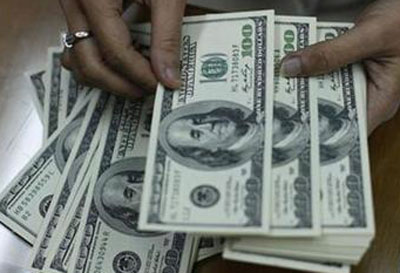
 NEW YORK: The dollar strengthened sharply against the euro Tuesday after prices in Germany declined month-over-month, renewing concerns about low inflation in the eurozone.
Prices in Germany, Europe's biggest economy, fell 0.2 percent in April from March, according to the federal statistics office Destatis.
"The big question now is whether this further surprising weakness will transpire in other member states' April inflation data," said Barclays analyst Francois Cabau.
He said Barclays was revising down its April "flash" eurozone inflation estimate to 0.7 percent, following a mere 0.5 percent rise in prices in March.
Economists worry that ultra-low inflation could stall the patchy European economic rebound, stifling investment and demand. The European Central Bank's has a 2.0 percent annual inflation rate target for price stability.
Traders were looking ahead to the conclusion Wednesday of the Federal Reserve's two-day policy meeting and the government's initial estimate of US gross domestic product (GDP) growth in the first three months of the year.
The Fed's Federal Open Market Committee, in a post-meeting statement, is expected to announce the central bank will cut $10 billion from its monthly bond-purchase stimulus, bringing it to $45 billion. The FOMC was virtually certain to keep its key interest rate near zero, where it has been for more than five years.
"The dollar may even have a more pronounced reaction to GDP than FOMC because the Federal Reserve is widely expected to reduce asset purchases by another $10 billion this month," said Kathy Lien of BK Asset Management. "For the most part we expect the (FOMC's) statement to remain virtually unchanged.




















Comments
Comments are closed for this article.