



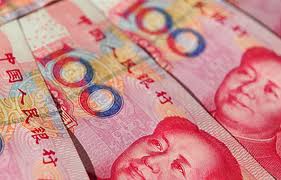
 HONG KONG: The Chinese yuan fell on Monday and extended its worst weekly performance in more than two years after the People's Bank of China fixed the daily midpoint weaker for a fifth session.
A more than 2 percent drop in the daily yuan midpoint fixings by China's central bank since last Tuesday has outpaced the dollar's rise against a trade-weighted basket of currencies in that period, raising speculation the PBOC is taking active steps to deter arbitrage-seeking hot money inflows.
The yuan has been a favorite in the emerging market currency space in 2013, gaining more than 3 percent while most of its peers depreciating against the dollar.
Its attractiveness has grown in recent months as a relatively stable currency along with higher onshore yields prompted speculators to buy the yuan betting on more gains.
UBS strategists estimate that net non-FDI capital inflows, loosely defined as "hot money" flows contributed more than $150 billion to the $433 billion increase in foreign exchange reserves in 2013.
Signs of weakening in the world's second biggest economy have also triggered a change in recent weeks in one of the most crowded positions in emerging markets, i.e., being long the Chinese currency versus the US dollar.
On Monday, the Chinese currency fell to an intraday low of 6.0990 per dollar compared to Friday's close of 6.0914. The People's Bank of China fixed the daily midpoint at 6.1189 per dollar, a fifth consecutive lower daily fixing.
It was last changing hands at 6.0945 per dollar, bringing its losses to 0.6 percent against the greenback so far this month.
While the magnitude of the declines in the onshore market have been relatively contained thanks to the presence of large state-run banks, the offshore market in the Chinese currency has borne the brunt of the selling.
Friday's 0.4 percent drop in the offshore yuan, or the "CNH" as it is popularly known, was the biggest one day fall since October 2011, according to Reuters data.
Despite the yuan's big drop last week, analysts don't expect a sharp devaluation of the currency especially given large foreign direct investment inflows and China's big current account surplus.
Data this month showed the country's trade surplus rising to $31.9 billion, well above forecasts of $23.7 billion and December's $25.6 billion, though some of that increase may be inflated by fake trade transactions.
Traders said the yuan's drop in the offshore markets has also been amplified by a pile up of long yuan bets via the derivatives market which has come under pressure since last week and forced some banks to cut these trades.
"This (yuan weakening) has nothing to do with macro-economics, " said Cliff Tan, East Asian head of global markets research at Bank of Tokyo-Mitsubishi UFJ Ltd in Hong Kong.
He said the long term direction of the yuan is still up, adding that "it's quite undervalued."


























Comments
Comments are closed for this article.