



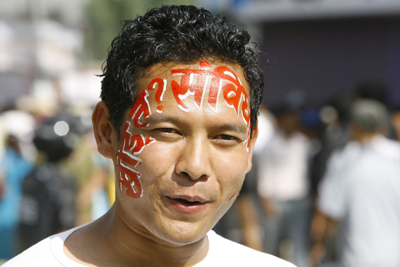
 KATHMANDU: Thousands of people gathered outside Nepal's parliament on Saturday to press lawmakers to extend the term of the assembly and avert a looming constitutional crisis in the troubled Himalayan nation.
With just hours to go before parliament's term expires, desperate efforts were under way to secure the survival of the assembly, elected in 2008 in landmark general elections that followed a 10-year civil war.
Nepal's parliament, or Constituent Assembly (CA), was elected on a two-year mandate to fulfil the terms of the peace agreement that followed the conflict and write a new constitution for the world's youngest republic.
Despite being given an extra 12 months in 2010, it has been unable to complete either task, amid fierce disagreements between the main political parties.
Unless lawmakers can agree on a fresh extension, its term will expire at midnight (1815 GMT) Saturday, leaving the country in legal limbo.
The coalition government, which includes the leftist UML (Unified Marxist-Leninist) and Maoist parties, has proposed a bill to give the assembly more time, but does not have the two-thirds parliamentary majority it needs.
The main opposition Nepali Congress (NC) party is refusing to vote for an extension unless the Maoists, who waged a decade-long insurgency against the state before winning 2008 elections, give up their arms.
But the Maoist party has so far refused to surrender its weapons to the government, resulting in a tense stand-off.
"There is no alternative but to extend parliament's term," said 48-year-old shop owner Jitman Thapa outside the CA building, where thousands of riot police were deployed.
"So many people have gathered here to voice their concern. But the leaders must deliver the constitution within the extended term."
The widespread hope that followed the end of the war in 2006 and the abolition of the monarchy two years later has been replaced by a growing sense of anger and frustration in Nepal, one of the world's poorest countries.
Political instability -- Nepal was without a government for seven months before the current prime minister was elected in February -- has stifled economic growth, forcing many Nepalese to seek work overseas.
Thousands of people have taken to the streets in recent weeks in protest at the slow pace of progress since the 2008 elections and politicians' failure to complete the constitution.
Police said 12 people had been arrested on Saturday for protesting outside the CA building, where barricades were erected to keep protesters away from the negotiations.
"The situation is volatile and we want to make sure that none of the groups take advantage," police spokesman Nawaraj Dhakal told AFP.
Analysts predicted the tense negotiations would continue well into the evening, with little clear indication of what would happen if no agreement could be reached.
The speaker of the house, Subas Chandra Nemwang, said the parties had no choice but to agree.
"They have time and again said that they are committed to the peace process and the constitution," he told AFP. "I hope they will put aside their differences and reach agreement on those two vital issues."
Copyright AFP (Agence France-Presse), 2011





















Comments
Comments are closed for this article.