



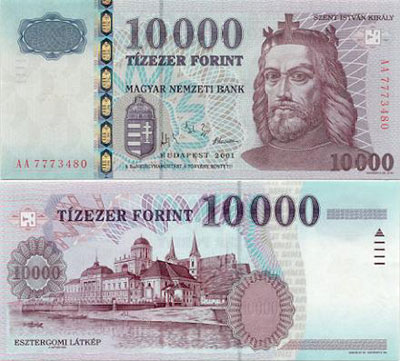
 BUDAPEST: Central European currencies rose on Monday, including the forint which recovered from an early dip triggered by a Hungarian court proposal on foreign currency loans which failed to clarify how banks would be affected.
The region's currencies and shares rose after a deal to curb the Iranian nuclear programme eased geopolitical tension and bolstered risk appetite and pushed down oil prices.
Hungary's central bank is expected to cut its base rate on Tuesday by 20 basis points to 3.2 percent to help the economy, but dealers do not expect the forint to weaken as a result unless the bank's rhetoric turns even more dovish.
The forint weakened slightly early on Monday after Hungary's top court confirmed it would rule on key aspects of foreign currency loans, including whether they were even legal.
By 1506 GMT, however, it had recovered and was 0.1 percent firmer against the euro, bolstered by rising appetite globally for riskier assets.
The court will discuss the issue on Dec. 16 to give guidelines to lower courts flooded by lawsuits against banks by the holders of once-popular foreign currency loans, whose costs have surged due to falls in the forint since the 2008 global crisis.
The government which faces elections in April and has urged a ruling, said the decision would define the framework for its own planned relief measures for borrowers.
The issue has created uncertainty about the cost to banks of settling the problem and dealers said Monday's proposal shed no new light on those costs.
"We learnt nothing today," one Budapest-based dealer said.
Raiffeisen said in a note on the region that "news on the FX repayment scheme poses the main risk to the HUF (forint) from a short-term perspective."
POLAND OUTPERFORMS
Shares of Hungary's biggest bank, OTP, fell 0.4 percent due to the uncertainty, bucking a 0.2 percent rise in Budapest's main equity index.
Shares in Warsaw hit a six-year high, rising more than 0.6 percent while the zloty gained 0.1 percent against the euro.
Poland's economy is seen picking up faster than Hungary, and its currency is expected to get support from the central bank whose next rate move is likely to be a hike next year, analysts have said.
Polish retail sales and jobless data on Tuesday are expected to provide more clues about the pace of economic recovery.
The Czech central bank earlier this month intervened to weaken the crown as part of monetary policy easing since interest rates are already virtually at zero.
It said it sold as much as $9.9 billion worth of crowns earlier this month to fight the threat of deflation, sending the Czech crown down by nearly 5 percent, a record, on the first day of the bank's intervention.


























Comments
Comments are closed for this article.