



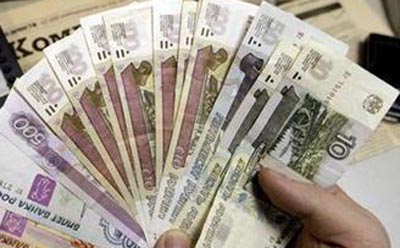
 MOSCOW: The Russian rouble weakened only marginally on Tuesday after the central bank warned of higher risks to economic growth, but analysts said the concerns signal potential future policy rate cuts that would pressure the currency.
The central bank left unchanged main policy rates at its monthly meeting, cutting rates for some operations above three months by 25 basis points and cautioning in a statement that the economy may be heading for a slowdown.
The rouble gave up two kopecks against the dollar on the news, trading at 31.14 at 1145 GMT, enough to put the currency at a new 2013 low and its weakest level since late November.
The rouble gave up three kopecks against the euro to 39.99 and it was three kopecks lower at 35.13 versus the dollar-euro basket which the central bank uses to gauge the rouble's nominal exchange rate.
"Given that in the statement there were notes of concern related to economic growth, a future reduction in interest rates cannot be ruled out, which could potentially put pressure on the rouble," Anton Zakharov from Promsvyazbank said.
Cutting rates still significantly higher than in many European countries reduces the rouble's appeal for carry trade operations.
"If the decision of the central bank is to be taken as a signal for cutting rates, this, in the long run will work against the rouble as interest in rouble assets will fall," Alexander Morozov, chief economist for Russia at HSBC in Moscow said.
Analysts polled by Reuters at the end of March had seen the rouble weakening to 33 rouble per dollar by end-2013.
Russian stocks gained on Tuesday, tracking growth in European markets that opened after the long weekend, boosted by March business activity data in the euro zone that was slightly better than the poor figure originally estimated.
The rouble-traded MICEX was up 0.3 percent at 1,432.96 points, while the dollar-denominated RTS index was up 0.2 percent at 1,449.10 points.
Trading remain thin, however with investors awaiting data on US factory orders for February and vehicle sales for March, due later in the day.
"Positive US macro data forecasts may support the bulls and therefore, the MICEX index may approach its nearest resistance level of 1,440 points, where long positions should be cut," Maria
Bolshakova, an analyst at Alor investment house, wrote in a note.
The yield on Russia's benchmark Eurobond maturing in 2030 inched down to 3.18 percent, from 3.23 percent at the opening.
Domestic bonds, so-called OFZs, saw their yields slightly recovering on the central bank news after a small decline at the opening.




















Comments
Comments are closed for this article.