



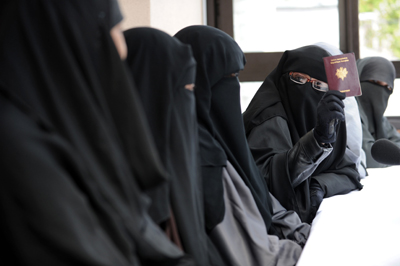
 PARIS: France home to Europe's biggest Muslim population -- on Monday officially banned women from wearing full-face veils in public places.
Other European countries have drawn up bans on the burqa and the niqab but France is the first to risk stirring social tensions by putting one into practice.
The law comes into effect at an already fraught moment in relations between the state and France's Muslim minority, with President Nicolas Sarkozy accused of stigmatising Islam to win back votes from a resurgent far right.
French officials estimate that only around 2,000 women, from a total Muslim population estimated at between four and six million wear the full-face veils that are traditional in parts of Arabia and South Asia.
But many Muslims and rights watchdogs accuse the rightwing president of targeting one of France's most vulnerable groups to signal to anti-immigration voters that he shares their fear that Islam is a threat to French culture.
Police on Saturday said they arrested 59 people, including 19 veiled women, who turned up for a banned protest in Paris over the ban, while two more were detained as they attempted to travel to the rally from Britain and Belgium.
Some critics worry the law may be hard to enforce, since it had to be drawn up without reference to religion to ban any kind of face covering in public and since police officers will not be allowed to remove women's head coverings.
Anyone refusing to lift his or her veil to submit to an identity check can be taken to a police station. There, officers must try to persuade them to remove the garment, and can threaten fines.
A woman who repeatedly insists on appearing veiled in public can be fined 150 euros (216 dollars) and ordered to attend re-education classes.
There are much more severe penalties for anyone found guilty of forcing someone else to hide his or her face "through threats, violence, constraint, abuse of authority or power for reason of their gender."
Clearly aimed at fathers, husbands or religious leaders who force women to wear face-veils, and applicable to offences committed in public or in private, the law imposes a fine of 30,000 euros and a year in jail.
Foreign extremists, including fugitive Al-Qaeda leader Osama Bin Laden have used the ban to argue France is at war with Islam, and have called for attacks.
Belgium's parliament has approved a similar law, but has yet to enforce it. In the Netherlands far-right leaders have proposed a ban, and in Italy the right-wing Northern League is lobbying for a ban on the French model.
It is hard to gauge the mood of the bulk of veil wearing French Muslim women, but two who agreed to speak to AFP -- who gave their names as Aya and Umm Isra -- said they would not challenge the ban in the street.
But, they added, if they can't wear their niqabs they will likely go out far less often, suggesting the ban could create a hidden underclass.




















Comments
Comments are closed for this article.