



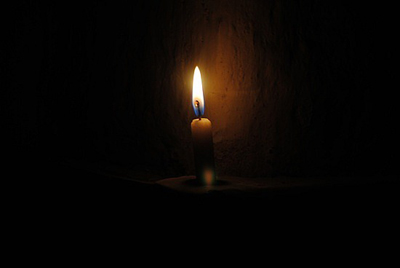
 KATHMANDU: By the light of a single candle Shankar Prasad Bhandari strains his eyes as he tries to count out the correct change for a customer in his blacked out shop on the outskirts of Kathmandu.
Rolling 14-hour power cuts, triggered by a growing energy crisis, mean that much of life in the Nepalese capital and across the Himalayan nation functions by candlelight these days.
The impact can been seen -- or squinted at -- everywhere. Television stations broadcast evening news programmes from studios in semi-darkness, while schoolchildren face a daily race with the sunset to complete their homework.
The economic cost has been enormous, with industries forced to reduce operations and small businessmen such as Bhandari closing their shops before what used to be the profitable evening shopping rush.
"I'm losing business and that's making it hard to support my family," the 42-year-old told AFP.
Nepal generates a measly 643 megawatts of electricity a year -- most of it from antiquated hydroelectric plants.
That is barely half of the national requirement and imports from India fail miserably to make up the shortfall.
Compounding the sense of public frustration is the fact that Nepal should, according to most experts, be an energy-producing powerhouse.
Feasibility studies suggest the country's vast mountain river system has the potential to generate up to 83,000 megawatts of hydropower.
But investment in infrastructure has been almost non-existent, largely due to a 10-year civil war between the government and Maoist rebels that only ended in 2006.
Chronic political instability in the wake of the Maoist victory exacerbated the problem, and it is only since the election of a new prime minister in February -- after a seven-month leadership vacuum -- that the issue has started to be addressed.
Last month, the government declared an energy emergency and announced a $275 million initiative to expand power generation capacity by an extra 2,500 megawatts over the next five years.
The plan envisages the construction of several hydroelectric projects and offers sweeping tax incentives to investors in the energy sector.
"If we don't immediately address the energy crisis, the country will be pushed into a horrible situation," said Finance Minister Bharat Mohan Adhikari.
Nepal suffers from a double-bind in that the winter season -- when demand for power is highest -- is also the dry season when rivers run lower and hydro generation is reduced by up to 30 percent.
The government's current load-shedding policy -- shutting off power to certain areas at designated times to conserve electricity -- is likely to remain in force at least until June when the monsoon rains arrive.
Water resource expert Ratna Sansar Shrestha said he was sceptical of the government's ambitious energy creation plan.
"This is in line with the same lofty pronouncements of previous governments, who have promised 10,000 megawatts in 10 years or 25,000 megawatts in 20 years," Shrestha said.
"Load-shedding is not a new phenomenon. We knew 10 years ago that we would face this. But nobody is serious about implementing the policies.
"I think this so-called plan will be no different from the others," he said.
All crises provide opportunities and Nepal's energy drought is no exception, offering a windfall for companies such as Techno Trade, which distributes diesel generators in Kathmandu.
Sales executive Saroj Rai said the firm had seen a 30 percent sales surge this winter season compared with last year, with buyers including individual households, small businesses like Internet cafes and larger institutions such as banks.
"You must install a generator if you want to run a business," Rai said.




















Comments
Comments are closed for this article.