


Iran says it launched military satellite as Trump threatens ships
- The Islamic Revolutionary Guard Corps hailed the launch as a milestone despite repeated US allegations that the space programme is a cover to develop ballistic missiles.
- The satellite "orbited the Earth at 425 kilometres (264 miles)" above sea level, said Sepahnews.
- Iranian state television aired footage from multiple angles of a rocket blasting off into a mostly clear blue sky.
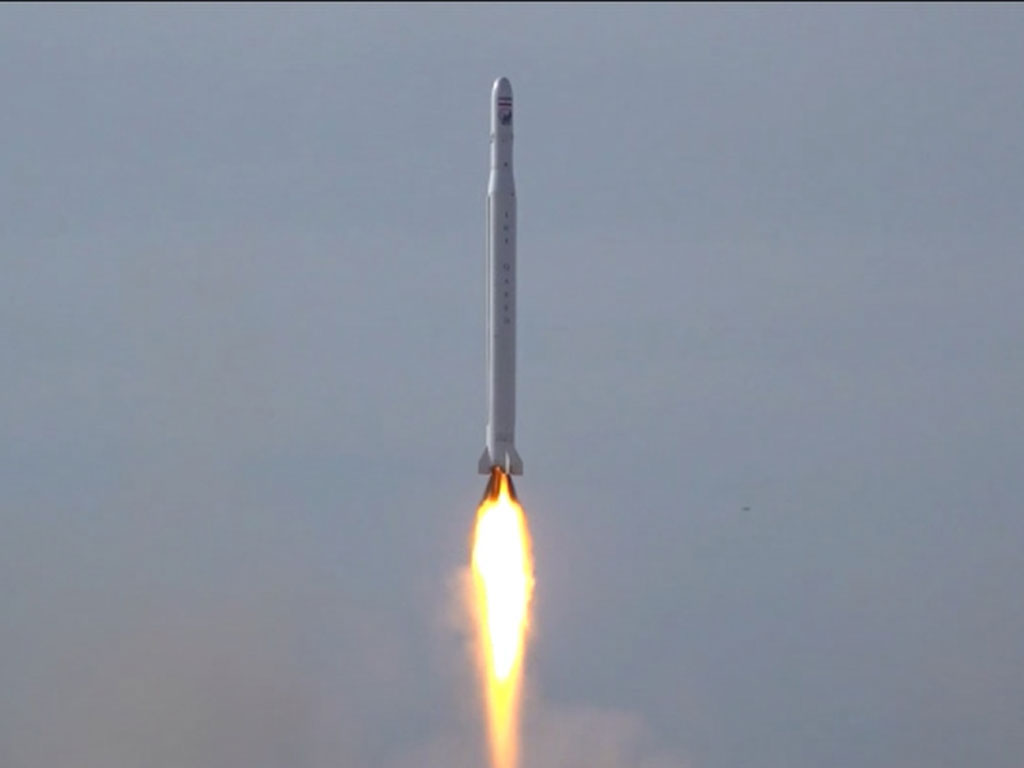 TEHRAN: Iran said it put its first military satellite into orbit Wednesday, making it an emerging "world power", as the US issued new threats amid rising naval tensions in the Gulf.
The Islamic Revolutionary Guard Corps hailed the launch as a milestone despite repeated US allegations that the space programme is a cover to develop ballistic missiles.
"Today, we are looking at the Earth from the sky, and it is the beginning of the formation of a world power," the Guards' commander Hossein Salami said, quoted by Fars news agency.
Tensions between the United States and Iran escalated again last week with Washington accusing its arch-foe of harassing its ships in the Gulf.
US President Donald Trump took to Twitter on Wednesday to say he had "instructed the United States Navy to shoot down and destroy any and all Iranian gunboats if they harass our ships at sea".
Secretary of State Mike Pompeo charged that the satellite launch proved US charges that Iran's space programme was for military rather than commercial purposes.
"I think Iran needs to be held accountable for what they've done," Pompeo told reporters in Washington.
Iran maintains it has no intention of acquiring nuclear weapons, and says its aerospace activities are peaceful and comply with a UN Security Council resolution.
Sepahnews, the Revolutionary Guards' website, said the satellite dubbed the Nour -- meaning "light" in Persian -- had been launched from the Markazi desert, a vast expanse in Iran's central plateau.
The satellite "orbited the Earth at 425 kilometres (264 miles)" above sea level, said Sepahnews.
Iran's regional rival Israel said it "strongly condemns" what it called Iran's "attempt" to launch a military satellite.
It urged more international sanctions for what it called "a facade" for Iran's continued development of advanced missiles, including ones that could deliver a nuclear warhead.
David Norquist, the US deputy defence secretary, said the Iranian launch "went a very long way".
The range "means it has the ability once again to threaten their neighbours, our allies. And we want to make sure they can never threaten the United States," he told reporters.
'Great national achievement'
Iranian state television aired footage from multiple angles of a rocket blasting off into a mostly clear blue sky.
The rocket bore the name Qassed, meaning "messenger", in what appears to be the first time Iran has used a launcher of this type.
Its fuselage also bore a Koranic inscription that read: "Glory be to God who made this available to us, otherwise we could not have done it."
There was no way to independently verify the details and timing of the reported launch.
Iran's Telecommunications Minister Mohammad Javad Azari Jahromi took to Twitter to congratulate the Guards' air force, adding he had visited the launch site three weeks ago.
"They were great," he said, describing the satellite as a "three-stage solid fuel" launcher.
Iran has repeatedly tried and failed to launch satellites in the past.
The most recent attempt was on February 9 when it said it launched but was unable to put into orbit the Zafar, which means "victory" in Persian.
High-seas encounter
Iran and the United States have appeared to be on the brink of an all-out confrontation twice in the past year.
Their long-standing acrimony was exacerbated in 2018 when Trump unilaterally withdrew from a multilateral deal that froze Iran's nuclear programme.
Tensions escalated again in January when the US killed Major General Qasem Soleimani, head of the Guards' foreign operations arm, in a drone strike in Iraq.
The Pentagon last week accused Iran of "dangerous and provocative" actions in the Gulf.
It said 11 Guards boats "repeatedly crossed the bows and sterns" of US vessels in international waters.
Iran said the US gave a "Hollywood" account of the encounter and warned that any "miscalculation will receive a decisive response".
The Islamic republic, battling one of the world's deadliest novel coronavirus outbreaks at the same time as dealing with crippling US sanctions, has accused Washington of "economic terrorism".
Tehran says the punitive measures have denied it access to medical equipment needed to fight the virus.
Iran has declared that the disease has claimed the lives of nearly 5,400 people and infected almost 86,000 since the outbreak emerged on February 19, but observers believe the numbers to be significantly higher.
Pompeo said the satellite launch showed Iran was disingenuous when it requested a $5 billion emergency loan to battle the virus from the International Monetary Fund, where the United States holds an effective veto.
"I would hope that the Iranian regime will respond to the Iranian people's demands to prioritise resources -- resources that the Iranian regime clearly has."


















Comments
Comments are closed for this article.