


Myths about Coronavirus - WHO says all these rumors are FALSE
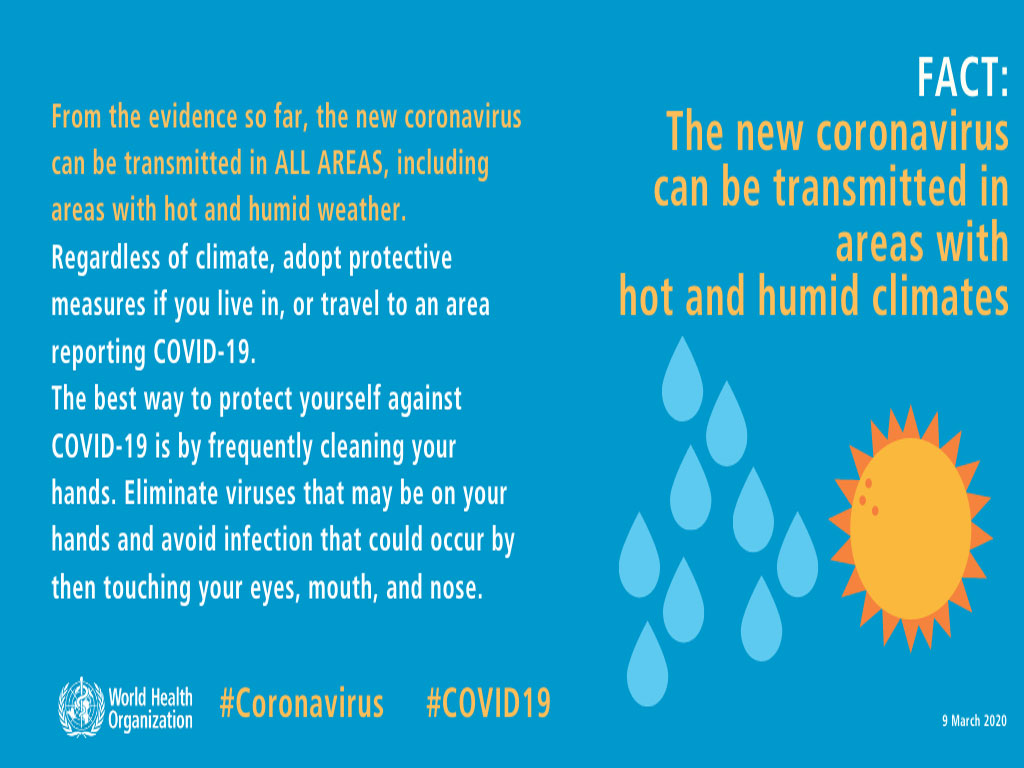
- WHO states coronavirus can transmit in both hot and cold weather.
- The virus does not spread through mosquito bites: WHO advisory.
- WHO mentions that thermal scanners fail to detect if a person is infected with disease or not.
 (Karachi) The World Health Organization (WHO) busted various myths regarding coronavirus (COVID-19). A recent public advice published by the health organization related to the disease revealed that most of the information circulating about the prevention of COVID-19 is false as this is a new and different virus.
In its advice, the WHO claimed the approach of the people towards prevention measures and protection from coronavirus is entirely based on false information. The answers to the myths are as follows:
- Virus can transmit in hot and cold weather
Regarding a myth that the virus cannot survive and transmit in hot and cold weathers, the WHO stated that coronavirus can be transmitted into people living in areas with hot and humid climate while there has been no evidence that cold weather kills the virus.
- Taking bath with hot water does not prevent disease
Similarly, the advice mentioned people think that taking bath with hot water prevents coronavirus which is not true. According to the facts, taking bath cannot guarantee that a person will not be infected with the virus. Hot water bath is effective in getting rid of germs on different body parts.
- Coronavirus does not spread through mosquito bites
The advisory further states many people believe that coronavirus spreads through mosquito bites. It highlights that the myth is not true and the virus does not transmit through mosquito bites. In fact, the disease is a respiratory virus which spreads through droplets generated when an infected person coughs, sneezes and discharges from nose.
- Hand dryers cannot counter COVID-19
Regarding another myth that hand dryers are effective in countering the virus, the report stated that this also not true as hand dryers are not effective in killing the COVID-19.
- Thermal scanners cannot detect coronavirus infection
Thermal scanners are effective in detecting people who have developed a fever because of infection with the new coronavirus. However, they cannot detect people who are infected but are not yet sick with fever. This is because it takes between two to ten days before people who are infected become sick and develop a fever.
- Spraying alcohol or chlorine not effective for virus
The advisory states that spraying alcohol or chlorine all over the body cannot prevent coronavirus. They can be used to disinfect surfaces and not as a means to kill the virus.
- No evidence pets are infected with deadly virus
Till date there is no evidence or information that cats and dogs can be infected with coronavirus. Only human-to-human transmission of the disease has been reported so far.
- Pneumonia vaccines fail to protect against COVID-19
The report mentioned that pneumonia vaccines are not effective and fail to provide protection against the virus. The virus is so new that it needs its own vaccine.
- Regularly rinsing nose with saline not effective
There is no evidence that regularly rinsing the nose with saline has protected people from infection with the new coronavirus. There is some limited evidence that regularly rinsing nose with saline can help people recover more quickly from the common cold. However, regularly rinsing the nose has not been shown to prevent respiratory infections.
- Consuming garlic cannot treat virus
There is no evidence that eating garlic prevents a person from getting infected with coronavirus. However, garlic is useful and good for health and has anti-microbial properties.
- People of all ages prone to coronavirus
There is a myth that elderly and small children are more at risk of getting infected with the disease which is not true. In reality, coronavirus can infect any person regardless of his age. However, those sick and suffering from multiple diseases are more vulnerable to contract the virus.
- Antibiotics cannot treat virus but bacterial infections
There is an assumption that antibiotics can prevent coronavirus which is false. Antibiotics are only effective against bacterial diseases not viruses. Secondly, antibiotics are helpful to fight against bacterial infections but as far as coronavirus is concerned, scientists are striving to prepare its vaccine.
- No specific medicines for treatment of COVID-19
There are no specific medicines to treat the disease. Health practitioners only recommend precautionary measures and appropriate care to relieve and treat symptoms.
Precautionary measures
The WHO advisory highlights that only precautionary measures can prove helpful to stop transmission of the deadly disease.
- One simple way is to wash hands to eliminate the virus and prevent any kind of infection.
- A person should maintain at least 1 metre (3 feet) distance from anyone who is coughing or sneezing.
- There is need to avoid touching eyes and nose as hands can pick viruses.
- People should follow good respiratory hygiene and cover mouth and nose.
- A person showing coronavirus symptoms should seek immediate medical attention.



















Comments
Comments are closed for this article.