


Indus Dyeing & Manufacturing Company Limited
<B>About the company</B>
One of the older names in the textile industry, the Indus Group has been in textile business for over 50 years. The group's flagship company, Indus Dyeing & Manufacturing Co Limited (PSX: IDYM) was incorporated in Pakistan in July 1957 as a public limited company. Today, the firm boasts a market capitalisation of over Rs 8.35 billion.
Indus Dyeing's core business is the manufacturing and sale of yarn, which accounts for more than 90 percent of its revenue. Currently, the company has three yarn manufacturing units at Hyderabad, Karachi, and Muzaffargarh. It is also operating three ginning units, including two on leasing arrangements and two ice factories on leasing arrangements in Multan.
The company has also invested in a joint venture, Indus Home Limited and in an associate, Sunrays Textile Mills Limited. It also acquired 100 percent shares of Indus Lyallpur Limited (formerly MIMA Cotton Mills Limited).
Stock and Pattern of Shareholding
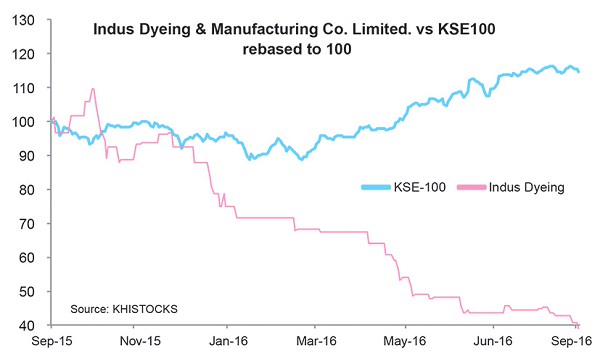
It clearly hasn't been a good year for IDYM; since December, the stock has been on an unabated nosedive, losing more than half its value year-to-date. The stock has remained well below the KSE100 index throughout the period. Indeed, FY16 has been a horrible year for the company, with losses in each quarter thus far.
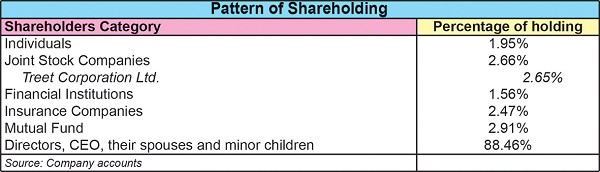
That said, the majority of the shares by far are within the company's own hands, with individual traders holding less than two percent of the total. The only major investor in the company seems to be Treet Corporation.
Prior Performance
Indus Dyeing's top line has been increasing steadily, with a compound annual growth rate of 2.67 percent from FY11 to FY15. Things went awry for the company in FY12, when a precipitous decline in cotton prices drove down the firm's revenues and profit. Since then, sales have bounced back and continued to grow, albeit the profitability has been going southward and finding new lows. As of FY15, net margins had fallen to just over one percent.
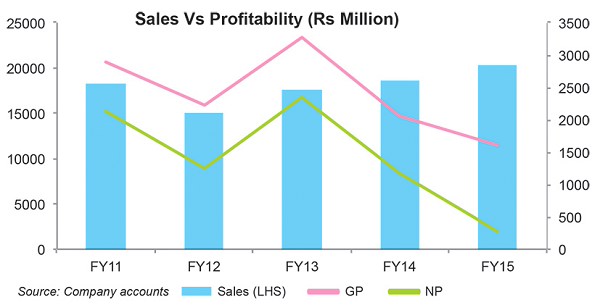
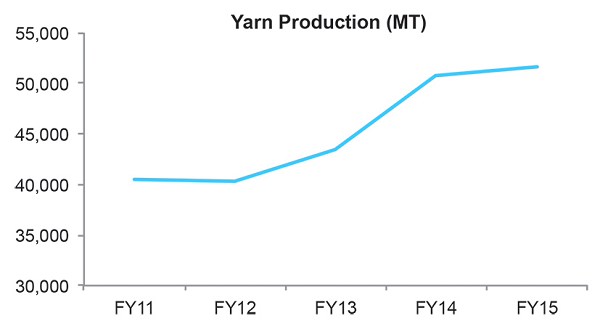
Around 80 percent of the firm's revenues come from exports. Although the exports are growing in value, they are bringing lower profit each year. The company continues to suffer from the same fate as all other textile spinners; lower yarn prices over the past couple of years have driven down profits. Despite the investment increasing its capacity and notably higher production each year, Indus Dyeing is helplessly watching its bottom line decline each passing year in keeping with the cutthroat competition with regional players from India and Vietnam.
Moreover, yarn is the company's only product (aside from yarn waste), so it has little to fall back on. As for a domestic market, Indus Dyeing has not really made much of an effort to improve its share locally. Historically, the domestic yarn sales have remained flat as a percentage of total sales, at around 19-20 percent.
Recent Performance
And finally came fiscal '16 that happened to be one of the worst years in the company's history, resulting in a bottom line loss; for the nine months ended FY16, Indus Dyeing's top line dropped by 16 percent, while gross profit halved over the period. The net loss was Rs 54 million, compared to a profit of Rs 475 million a year ago.
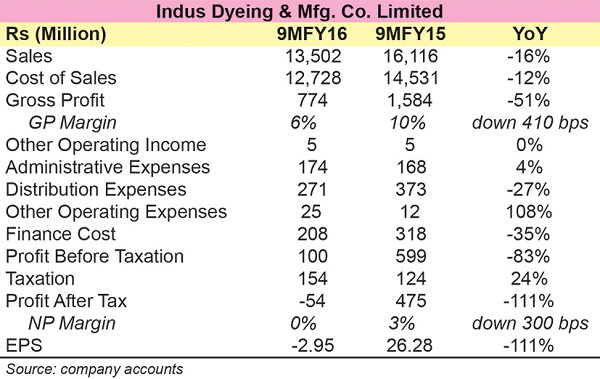
The textile industry has been in dire straits for some time now. Significant factors that have impeded the company's (and the whole sector's) growth were mentioned in the last annual Director's Report. These included: the lacklustre demand of textile products in the international market (mainly China); the strengthening of Pak Rupee against US Dollar; serious internal issues such as the hike in electricity tariff, energy crisis, and political instability; and the fall in cotton prices.
Moreover, FY16 was particularly awful because of the lower cotton crop in Pakistan, which necessitated heavy import of cotton at relatively high cost, further exacerbating the issue. As it stands, there is a duty of four percent on the import of cotton. Making matters worse, the authorities have yet to issue outstanding sales tax refunds, causing issues of liquidity for the struggling company. With little domestic presence, Indus Dyeing has also been unable to hugely benefit from the 10 percent protective RD on yarn given to spinners during the period under review.
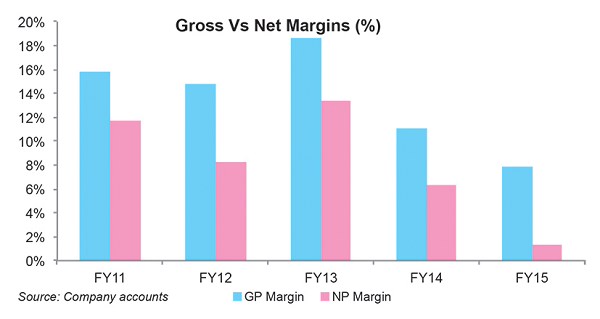
On a rare positive note, the company's finance cost declined substantially owing to lower interest rates, and uninterrupted supply of LNG had been provided.
Future Outlook
The results for the full year aren't out yet but there's little question as to how Indus Dyeing's performance might have been. Looking ahead, for FY17, there's hope that the zero-rating on exports to the five export-oriented sectors along with disbursement of pending refunds will help matters. However, the global situation is unlikely to change any time soon, and the industry has yet to be made competitive by lowering the cost of doing business in the country.











Comments
Comments are closed for this article.