


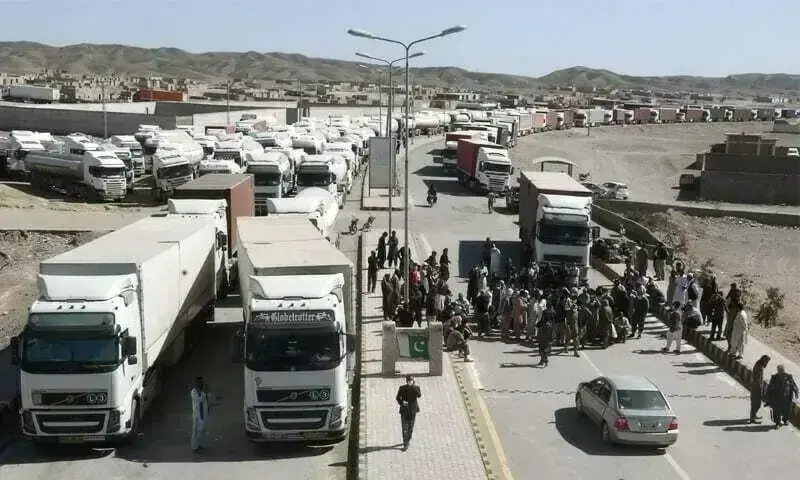
ISLAMABAD: The Ministry of Commerce (MoC) on Wednesday defended the government’s decision to suspend bilateral and transit trade with Afghanistan, stating that Pakistan could not afford further loss of human lives in the name of trade, while acknowledging that the closure had adversely affected exports and regional connectivity.
Testifying before the National Assembly Standing Committee on Commerce, chaired by Javed Hanif Khan, Secretary Commerce Jawad Paul said suspension of trade with Afghanistan had resulted in a decline of around USD1 billion in Pakistan’s exports.
Defending the decision, he said it had been taken on national security grounds, emphasising that national security remained the government’s foremost priority.
READ ALSO: Central Asia access: Pakistan activates westward trade corridors via China, Iran
“National security is the most important,” Secretary Commerce stated.
Javed Hanif questioned the rationale behind suspending trade with Afghanistan, pointing out the economic consequences of the decision, particularly the loss of export opportunities and disruption of trade routes to Central Asian states.
The Secretary Commerce said exports to Central Asian countries through Afghanistan had also declined, while Pakistan’s exports of oranges and potatoes had been adversely affected.
He further stated that bilateral trade with India had remained suspended since 2019. However, he acknowledged that trade with India was taking place indirectly through third countries, including the United Arab Emirates (UAE).
Javed Hanif observed that despite tensions between China and India, the two countries had not suspended bilateral trade.
The Secretary Commerce informed the committee that Pakistan’s total exports, including services, stood at USD40 billion during FY2025-26, while merchandise exports were around USD32 billion.
He expressed optimism that merchandise exports would reach USD35 billion during FY2026-27, as average monthly exports currently stood at approximately USD2.9 billion.
He further stated that following discussions with the State Bank of Pakistan (SBP), remittances were expected to reach $55 billion.
Regarding the European Union’s Generalised Scheme of Preferences Plus (GSP+) facility, Jawad Paul informed the committee that the EU’s new mechanism would become effective from 2029, requiring Pakistan to submit an application in accordance with the prescribed requirements.
“The European Union has submitted its report on Pakistan to the European Parliament, which is satisfactory. We are safe till 2029,” he said.
He added that Pakistan would have to comply with five additional international conventions, in addition to the existing 27 conventions, to continue benefiting from the GSP+ scheme.
During the meeting, the Ministry of Commerce and the Ministry of Industries and Production exchanged differing views over trade statistics, particularly export figures.
Chief Executive of the Trade Development Authority of Pakistan (TDAP), Faiz Ahmed Chadhar argued that the Ministry of Industries and Production should focus on reporting industrial sector performance rather than intervening in trade-related matters.
Commerce Minister and Secretary Commerce expressed surprise over the data presented by Additional Secretary Industries Humaira Zia Mufti, who maintained that the figures had been obtained from the Pakistan Bureau of Statistics (PBS).
The committee also questioned the accuracy of the data presented by the Ministry of Industries and Production and directed both ministries to reconcile their respective statistics to ensure consistency and reliability.
The committee unanimously approved the Anti-Dumping Duties (Amendment) Bill, 2026.
The Secretary Commerce also briefed the committee on the adverse impact of the Iran-US conflict, disruptions in trade with Afghanistan and financial restrictions associated with Iran on Pakistan’s international trade.
He informed the committee that Pakistan incurred a trade loss of USD387 million during July-October due to disruptions associated with the regional conflict.
Bilateral trade with Gulf countries had been affected by the Iran-US conflict, although trade with these countries was gradually recovering, he said.
Pakistan’s exports of oranges, potatoes and other commodities had also been affected, while disruptions in shipping and higher port charges were increasing trade costs.
The Secretary Commerce said cargo vessels had been arranged to facilitate the supply of meat and other commodities to Gulf countries. However, shipping and port charges had increased.
He further stated that sanctions imposed on Iran had created difficulties for Pakistan’s bilateral trade with the neighbouring country, as banks were reluctant to facilitate transactions due to fear of sanctions.
The government had closed the Gabd-Rimdan border crossing in view of sanctions-related concerns, although partial trade between Pakistan and Iran was continuing.
The Secretary Commerce said some LPG consignments had arrived from Iran, while the possibility of disruption in LPG supplies remained a concern. LPG imports had increased during July-October, he added.
Regarding exports to Central Asian countries through Iran, he said the government had introduced an e-form facility for Pakistani exporters. Last year, a relaxation was provided for exports of oranges and potatoes to Central Asian countries through Iran.
The facility was introduced to protect Pakistani companies from possible sanctions arising out of trade with Iran, he added.
The National Assembly Standing Committee on Commerce also expressed concern over the government’s decision to import sugar last year and subsequently export the surplus commodity.
Chairman Committee Javed Hanif questioned the rationale behind importing sugar last year and exporting it now.
“You imported sugar last year and are now exporting it,” the Chairman observed.
Officials of the Ministry of Commerce informed the committee that approximately 300,000 tonnes of sugar had been imported last year, of which around 200,000 tonnes had been consumed domestically, while the remaining 100,000 tonnes were available for export.
They said sugar had been imported to meet domestic requirements after prices increased in the local market.
Officials of the Ministry of National Food Security and Research informed the committee that the cultivated area under sugarcane had increased during the current year.
They further stated that sugarcane production stood at 97.28 million tonnes, while 89 sugar mills were currently operational in the country.
The committee directed the Ministry of National Food Security and Research to provide import and export data of sugar and wheat for the last five years.
The Chairman Committee also directed the ministry to explain the financial implications of the import-export practices for the national exchequer and quantify the cost incurred by the government.
The committee sought details of decisions regarding sugar and wheat imports and exports, including their impact on domestic prices and public finances.
According to the press release, the Committee also considered the Trade Organizations (Third Amendment) Bill, 2026, a Private Member’s Bill moved by Dr. Farooq Sattar, MNA, particularly with regard to the status of the Karachi Chamber of Commerce. The Committee reiterated its earlier position that the organizational structure of chambers should be based on divisional-level arrangements rather than individual districts.
Accordingly, the Bill was referred to the Legislative Drafting Branch of the National Assembly Secretariat for necessary legislative drafting and technical refinement. The Committee decided that, upon completion of the drafting process, the finalized draft would be forwarded to the Committee for its consideration.
The Committee further examined discrepancies in industrial production and export data reported by the Ministry of Industries and Production. It emphasized the need for improved coordination and a unified data reporting mechanism to reconcile production figures with export performance and actual exportable surpluses.
The Committee also highlighted the estimated untapped export potential of USD5.9 billion across 20 high-potential product categories identified through the International Trade Centre’s analysis and stressed the need for sector-specific strategies to enhance export competitiveness and diversify markets.
The Committee meeting concluded with a vote of thanks by the Chair to the Members for their valuable participation and contributions to the deliberations.
The meeting was attended by MNAs, Khurshid Ahmed Junejo, Dr. Ramesh Kumar Vankwani, Farhan Chishti and Mir Amir Ali Khan Magsi in person. Dr. Farooq Sattar Mover of the Bill also attended the meeting.
The senior officers from Ministry of Commerce, Ministry of Law & Justice, Ministry of Industries and Production, Ministry of National Food Security and Research and National Assembly Secretariat were also present in the meeting.
Copyright Business Recorder, 2026

















Comments