


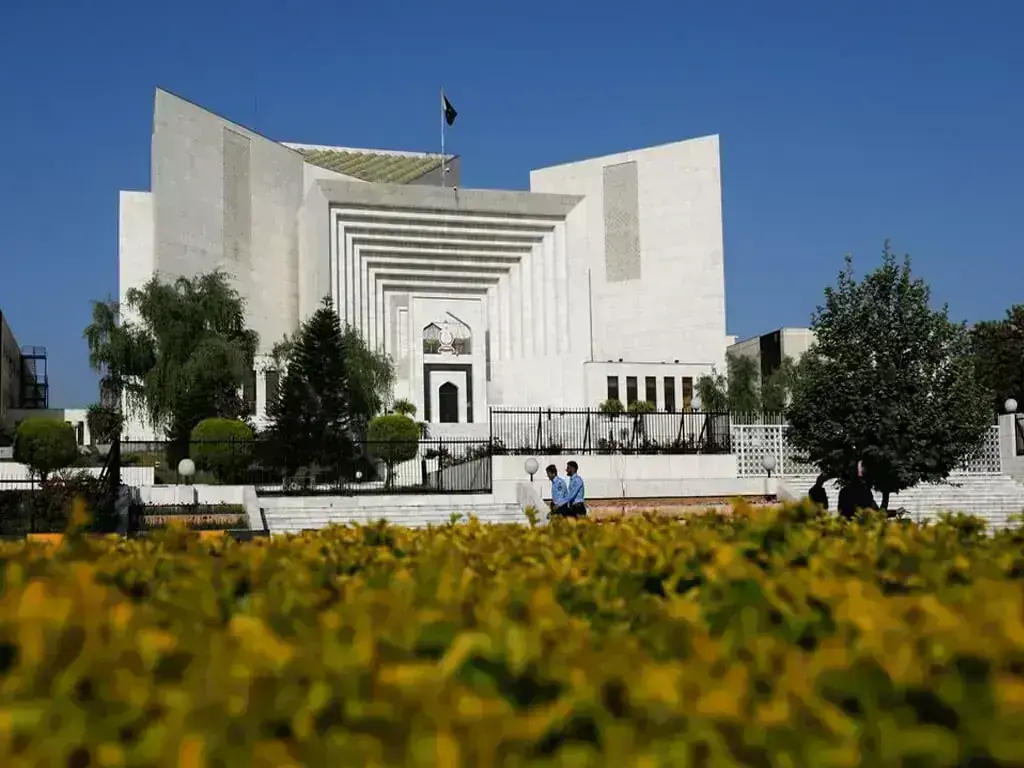
ISLAMABAD: The Supreme Court has ruled that the Zarai Taraqiati Bank Limited (ZTBL) cannot be regarded as a company whose entire shareholding is directly or indirectly owned by the federal government.
“The shareholdings of the provincial governments, vanishingly small though they may otherwise be, are decisive,” observed a three-member bench in a judgment authored by Justice Munib Akhtar.
The total number of shares of the appellant (ZTBL) stood at 5,267,843,241. Of these, according to the bank’s register of members, 1,251,189,067 shares were held by the federal government, while 4,015,599,174 were held by the State Bank of Pakistan (SBP).
The judgment noted that the federal government directly held 23.76% of the shareholding, while the bulk of the shares, constituting 76.22% of the share capital, were held by the SBP.
The SBP is a statutory body created by the eponymously titled Act of 1956. According to Subsection (3) of the Act: “The capital shall be fully paid-up and held exclusively by the Federal Government and shall not be transferable to any other person or entity”. The judgment said that in view of this categorical statutory statement, the shares held by the SBP can indirectly be regarded as being owned by the federal government. “The respondents’ counsel is correct in asserting that 99.98% of the shares in the appellant are held, directly or indirectly, by the federal government,” it added. However, the balance shares (minuscule though those shareholdings may be) are held by the provincial governments, noted the judgment.
These matters arose out of the Income Tax Ordinance, 2001, by way of appeals under the proviso to subsection (13) of Section 134A thereof. The appeals have been filed against the decision of the Committee constituted under the section for Alternate Dispute Resolution.
It is common ground that the appellant is a state-owned enterprise (SOE) within the meaning of the State-Owned Enterprises (Governance and Operations) Act, 2023 (SOE Act). The appellant’s case is that it is not wholly owned, directly or indirectly, by the federal government and hence the appeals are maintainable. The respondents however contend that the appellant is wholly so owned and that therefore it is subsection (12) that applies. Therefore, the appeals are not maintainable.
Copyright Business Recorder, 2026



















Comments