


Why factories can’t simply leave the grid
Going fully off-grid with solar and batteries is impractical for Pakistani factories due to winter, storage, land, and cost, making it nearly three times more expensive than grid power.
- The four major obstacles to industrial grid defection.
- How winter and fog dictate off-grid system size.
- The substantial land and battery storage requirements.
- Why off-grid electricity costs nearly three times the grid.
- The future of industrial power consumption and grid reliance.

I was recently invited to speak at an energy event, and what stayed with me was not the talks but the questions. Again and again, industrialists asked the same thing: could they take their factory off the grid altogether, with solar on the land and batteries in the yard?
Pakistan imported 4.6 GWh of lithium-ion batteries in 2025, more than three times the year before, and industry already holds about 2 GWh of them (Renewables First, 2026). Yet elsewhere in the world, factories add solar and batteries but stay connected; very few have cut the cable entirely. Is Pakistan different, or does the arithmetic catch up with everyone? I decided to run the numbers.
It is an appealing idea, until you try to size it. Full grid defection runs into four obstacles: winter, storage, land, and cost. To see how large they are, I followed one ordinary factory through a Punjab winter.
The test factory
Our example is a 20 MW processing or engineering unit in central Punjab with a 50 percent load factor, using 240 MWh a day. We assume 16 hours of operation, from 6 am to 10 pm, averaging about 14 MW with peaks of up to 20 MW, followed by an 8-hour low-load period when only auxiliary loads such as lighting and utilities run, at about 2 MW. All figures assume this load; a plant with higher demand needs proportionally more solar, battery and inverter capacity. The analysis is also deliberately generous: it uses a simple daily energy balance, allows for only one sunless day and leaves out the cost of land, so the real requirements for going off-grid would be higher still.
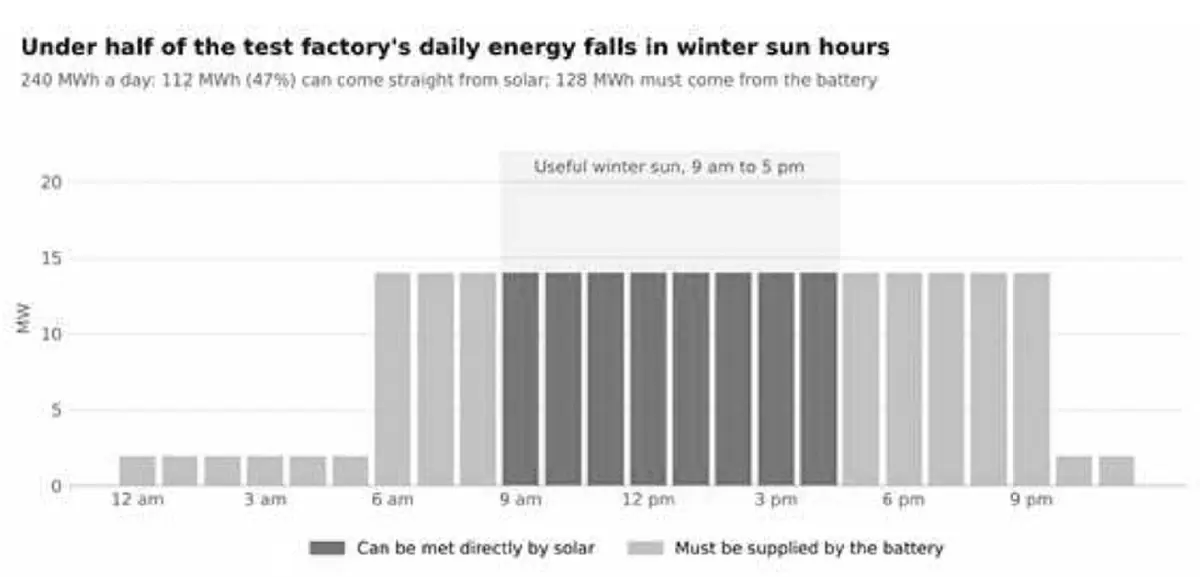
Assumed duty cycle of the test factory, winter design day
Obstacle 1: Winter
The obstacle: an off-grid factory must be built for its worst month, not its average day. With no grid to fall back on, December and January decide the size of everything.
Lahore’s solar output is about 6.5 kWh per kWp per day in spring but only 3.5 in winter (NASA POWER); the darkest weeks are lower still, so we design for 3.2. Fog makes it worse: the Meteorological Department has recorded fog on 15 to 20 days a month across eastern Punjab in December and January, often for days at a stretch (PMD). Useful sunshine lasts only from about 9 am to 5 pm, when the factory uses just 47 percent of its daily energy.
To produce enough energy on a winter day, the factory needs about 105 MWp of solar panels, more than five times its 20 MW peak demand. In summer, the same panels produce far more than the plant can use, and roughly half of the year’s output is wasted.
Obstacle 2: Storage
The obstacle: the battery must cover every evening and night, plus every day without sun. This is where the advantage of a daytime-heavy schedule largely disappears.
The sun sets around 5:15 pm, but operations run at full load until 10 pm, and the early morning also falls outside the solar window. With the overnight auxiliary load, the battery must supply about 130 MWh a day, only a fifth less than a flat 24-hour load would need.
Fog is the bigger problem. On a sunless day the battery must carry the full 247 MWh on its own. Allowing for losses, usable depth and 15 years of ageing, which takes it to about 560 MWh, roughly 12 percent of all the batteries Pakistan imported in 2025.
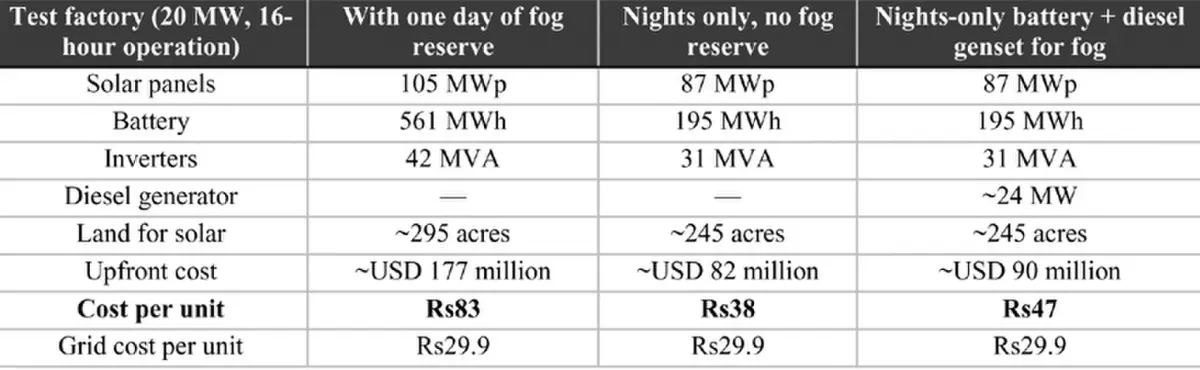
Its inverters, which must run the whole plant and recharge the battery in a few sunny hours, need about 42 MVA, twice the factory’s peak.
Obstacle 3: Land
The obstacle: a solar plant sized for winter needs far more land than a factory has. A factory roof can hold a few megawatts at most. The rest must go on the ground.
Ground-mounted solar needs about 2.8 acres per MWp, so 105 MWp takes about 295 acres, before the battery yard and substation.
Spare land on that scale next to an industrial estate in central Punjab is rare, and its cost is left out here.
Obstacle 4: cost
The obstacle: once the system is big enough for winter and fog, its electricity costs far more than the grid’s.
The estimate uses current Pakistani prices of about USD 400 per kW for solar and USD 240 per kWh for batteries, spread over 15 years at a 10 percent cost of capital (Rs280 to the dollar, land excluded). The grid comparison is the full B-4 bill under the CY2026 tariff: Rs26.43 per unit plus Rs1,250 per kW of maximum demand a month, about Rs29.9 per unit before taxes.
A reliable off-grid supply costs about 2.8 times the grid; even the stripped-down version, which would shut the factory on the first foggy morning, costs 30 percent more. IRENA (2026) puts firm solar-plus-storage below USD 85 per MWh, but only at 95 percent reliability: the last 5 percent of hours is what makes full self-supply so costly.
An owner could instead pair a nights-only battery with a diesel generator for foggy days. Running about 15 days a year, a 24 MW genset brings the cost to about Rs47 per unit, still 1.6 times the grid, and adds new problems. At OGRA’s current Rs399 per litre, generator power costs about Rs108 a unit in fuel alone and exposes the factory to oil and currency shocks. Generators also need maintenance, spare parts and fuel storage, are noisy, and burn about a million litres a year, roughly 2,600 tonnes of CO?.
Does a bigger factory, or a better site, change the answer?
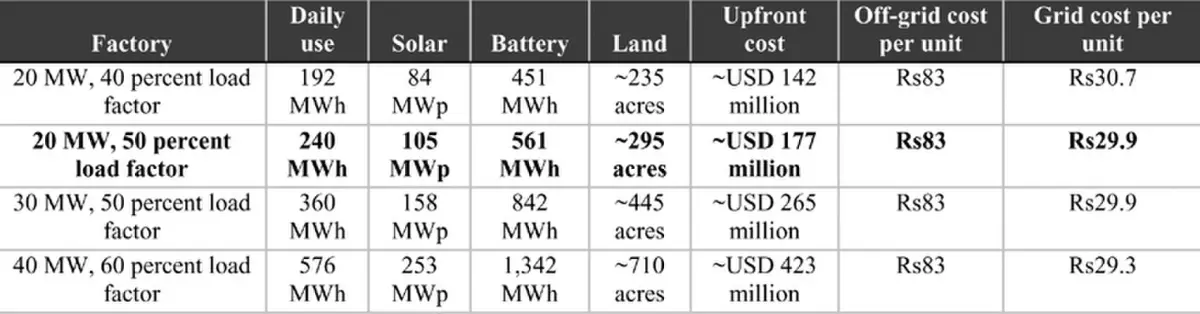
Scale does not help. The same 16-hour operating pattern and one day of fog reserve give much the same result across factory sizes and load factors:
Because equipment grows with energy use, every case costs about Rs83 per unit, nearly three times the grid. A round-the-clock spinning mill is worse: at the same 20 MW peak and about 85 percent load factor it uses 408 MWh a day, only a third in sun hours, and would need about 180 MWp of solar, over 1,000 MWh of battery and some 500 acres, at around Rs89 per unit against Rs28.4 from the grid.
A sunnier site helps only a little. Near Karachi, winter output is about 5.2 kWh per kWp per day (NASA POWER) with no fog, cutting the cost to about Rs77 per unit. Adding Gharo–Jhimpir wind saves a few rupees more, because Sindh’s wind is weakest in the very winter months that set the design (Energies, 2022).
What this means
The real test is Pakistan’s large industrial consumers. The B3 and B4 categories make up barely 1 percent of industrial connections but buy close to 60 percent of industrial electricity, mostly continuous-process plants such as cement, steel and spinning that run around the clock. For them, all four obstacles above only grow, and leaving the grid would cost nearly three times what they pay today.
Winter sets the size of the solar plant. Fog sets the size of the battery. Together they need land the factory does not have, and the bill comes to more than twice what the grid charges.
So industry will stay connected, but it will buy fewer units. It will use solar by day, batteries for the evening peak and the grid for winter and fog. That partial defection is the real challenge for the DISCOs.
The answer lies in tariff design: fixed and standby charges that match the capacity a factory keeps in reserve, not penalties on solar and storage. A grid priced as a reliable backup can keep these customers; one priced only by the unit will keep losing them.
Copyright Business Recorder, 2026
Engr Syed Faizan Ali Shah, PMP
The writer is a power sector expert with 2 decades of experience in the Power Generation, Transmission, and Distribution Systems. He can be approached at [email protected]



















Comments