


International Steels Limited: performance and outlook
ISL experienced fluctuating financial performance from 2021-2026, with significant growth in 2021 and 2026 driven by exports, and a strong Q1FY27, despite earlier challenges.
- ISL's financial performance and margin trends from 2021 to 2026.
- Key factors influencing sales and profitability, including economic conditions and export strategies.
- Strategic divestment of CECL shares and future investment plans.

International Steels Limited (PSX: ISL) was incorporated in Pakistan as a public unlisted company in 2007. The company is a subsidiary of International Industries Limited. ISL is engaged in the manufacturing of cold rolled, galvanized and color coated steel coils and sheets.
Pattern of Shareholding
As of June 30, 2026, ISL has a total of 435 million shares outstanding which are held by 7654 shareholders. International Industries Limited, the holding company of ISL, has the majority stake of 56.33 percent in the company followed by local general public holding 14.10 percent shares.
Sumitomo Corporation, an associated company of ISL, holds 9.08 percent of its shares.
Strategic investor accounts for 4.74 percent of the company’s shares while directors, CEO, their spouse and minor children hold 3.50 percent shares. Around 3.44 percent of ISL’s shares are held by mutual funds, 2.63 percent by NIT & NBP funds, 2.45 percent by public & other companies and 2.09 percent by banks, DFIs and NBFIs. The remaining shares are held by other categories of shareholders.
Financial Performance (2021-26)
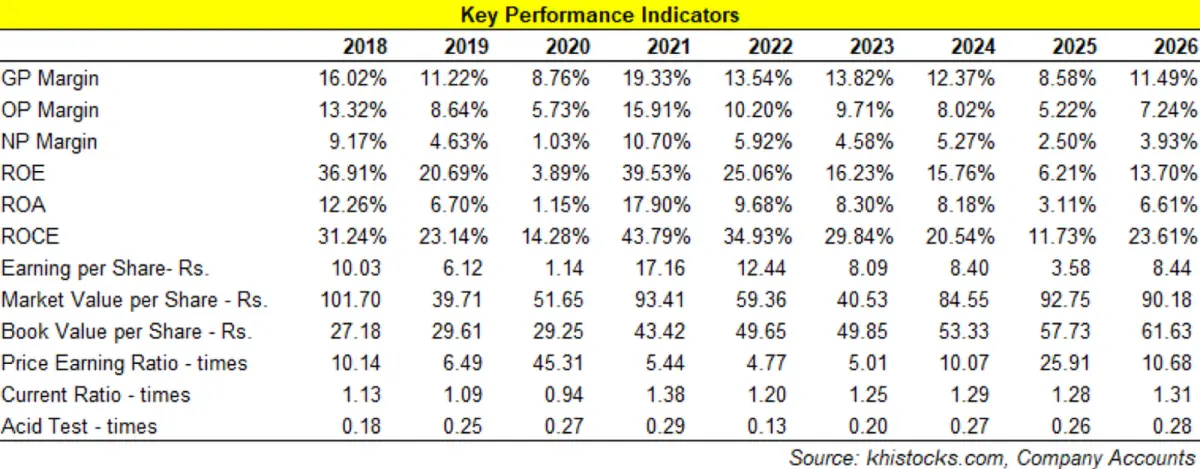
During the period under consideration, ISL’s topline slid thrice i.e. in 2023, 2024 and 2025. Conversely, its bottomline plunged in 2022, 2023 and 2025. The company’s margins which rode a steep downhill journey until 2020, registered sound recovery in 2021 where the margins attained their optimum level. ISL’s margins drastically fell in 2022.
In the subsequent year, gross margins slightly ticked up while operating and net margins continued to erode. In 2024, gross and operating margins tapered while net margin picked up. All the margins drastically fell in 2025. This was followed by a reasonable growth in 2026. The detailed performance review of each of the years under consideration is given below.
2021 brought about 45.16 percent expansion in ISL’s net sales which was on account of sound recovery in all the sectors of the economy as the signs of COVID-19 began to subside. Automobile industry rebounded by 23.4 percent in 2021 providing great impetus to steel industry.
Overall, LSM registered 14.9 percent rise in 2021 compared to 10.2 percent decline in the previous year. ISL’s overall production increased by 19.42 percent year-on-year in 2021 to clock in at 492,000 MT.
The company’s galvanized sales increased by 23 percent in 2021 to clock in at 293,000 MT while cold rolled sales went up by 10 percent to clock in at 199,000 MT. Local sales were mainly propelled by automobile, construction, appliances and general fabrication sectors. The company was also able to grow its export sales by 11 percent in 2021 by setting its footprint in new markets.
Vigorous volumes coupled with upward revision in prices resulted in 220.25 percent growth in ISL’s gross profit in 2021 with GP margin reaching its optimum level of 19.33 percent from 8.76 percent in the previous year. 18.86 percent higher distribution expense incurred by ISL in 2021 was the effect of increased freight & forwarding, sales promotion, rent, rates & taxes as well as salaries.
Administrative expense posted 37.56 percent spike in 2021 on account of higher payroll as well as legal & professional charges incurred during the year. Increased profit related provisioning, donations and impairment loss on property, plant & equipment culminated into 281.94 percent taller other expense incurred by ISL in 2021.
Other income also magnified by 789.10 percent in 2021 primarily on the back of gain on re-measurement of GIDC. Income from bank deposits, government grant and gain on sale of fixed assets also contributed in driving up other income in 2021.
All these factors translated into 302.85 percent bigger operating profit posted by ISL in 2021 with OP margin reaching its highest value of 15.91 percent from 5.73 percent in 2020. Lower discount rate as well as reduced borrowing due to better liquidity position of the company resulted in 64.92 percent plunge in finance cost in 2021.
ISL posted 1408.80 percent rise in its net profit which clocked in at Rs.7466.33 million in 2021. This translated into EPS of Rs.17.16 and NP margin of 10.70 percent in 2021 versus EPS of Rs.1.14 and NP margin of 1.03 percent registered in 2020.
In 2022, ISL witnessed 31 percent year-on-year growth in its net sales. Production volume, however, tells a different tale as it slid by 16.5 percent year-on-year in 2022 to clock in at 411,000 MT. Sales volume was also in line with reduced demand and production.
Galvanized sales dropped by 18.088 percent in 2022 to clock in at 240,000 MT while cold rolled products sales dropped by 7.54 percent to clock in at 184,000 MT in 2022.
Commodity super cycle in the international market coupled with Pak Rupee depreciation, high inflation and lackluster demand didn’t allow ISL to pass on the high cost of sales to its consumers. This resulted in 8.23 percent year-on-year decline in gross profit in 2022 with GP margin marching down to 13.54 percent. 47 percent hike in distribution expense in 2022 was the outcome of exorbitant freight & forwarding charges due to spike in the prices of POL products. ISL enlarged its workforce from 693 employees in 2021 to 705 employees in 2022. This drove up the payroll expense, however, lower legal & professional charges resulted in 6 percent lower administrative expense in 2022.
ISL incurred hefty exchange loss of Rs. 617.018 million in 2022. This was, to a great extent, offset by lower profit related provisioning, lesser donations and no impairment loss incurred during the year, resulting in 6.2 percent escalation in other expense in 2022.
Other income also eroded by 36.37 percent in 2022 due to loss from power generation and lesser gain on re-measurement of GIDC. This resulted in 16.1 percent thinner operating profit recorded by ISL in 2022 with OP margin moving down to 10.2 percent.
Finance cost magnified by 62.89 percent in 2022 on account of monetary tightening as well as enormous working capital related borrowings. ISL’s bottomline diminished by 27.51 percent year-on-year in 2022 to clock in at Rs.5412.19 million with EPS of Rs.12.44 and NP margin of 5.92 percent.
In 2023, ISL witnessed 16 percent year-on-year plunge in its topline. Besides economic slowdown, high inflation, floods, depreciation of Pak Rupee as well as import restrictions, the sales of ISL were greatly impacted by tax exemptions provided to the companies in the FATA/PATA region.
Sales volume plummeted by 27.36 percent to clock in at 308,000 MT. In line with sluggish economic activity and the resultant low demand, production also shrank by 26 percent to clock in at 304,000 MT.
The company’s ability to reduce its energy cost through strategic planning as well as higher margins on export sales due to Pak Rupee depreciation translated in a slight uptick in GP margin which clocked in at 13.82 percent in 2023. This was despite 14.33 percent smaller gross profit recognized by ISL in 2023. Distribution expense tumbled by 36.2 percent in 2023 on account of lower freight & forwarding and lesser sales & promotion budget for the year.
Despite rationalization of workforce from 705 employees in 2022 to 688 employees in 2023, adjustment in minimum wages as well as higher legal & professional charges translated into 14.5 percent higher administrative expense incurred by ISL in 2023. Hefty exchange loss resulted in 41.71 percent spike in other expense in 2023.
Other income, on the other hand, shrank by 22.48 percent in 2023 due to greater loss from power generation, reduced government grant & re-measurement gain on GIDC as well as lesser gain on sale of fixed assets. Operating profit nosedived by 20 percent year-on-year in 2022 with OP margin contracting to 9.71 percent. Finance cost posted 71.19 percent spike in 2023 on account of monetary tightening. This pushed net profit down by 34.98 percent in 2023 to clock in at Rs.3518.79 million with EPS of Rs.8.09 and NP margin of 4.6 percent.
In 2024, ISL’s net sales dipped by 9.71 percent year-on-year. This was on account of reduced demand due to macroeconomic and political instability prevailing in the home market. Moreover, the tax exemptions given to the FATA/PATA region was further extended until June 2025.
During the year, local sales proceeds slid by 18.15 percent while export sales proceeds registered 33.87 percent improvement due to 42 percent higher export sales volume. In terms of product lines, galvanized product contributed the most to ISL’s sales mix followed by cold rolled products and by-products. In 2024, the revenue from galvanized products improved while the other two categories registered decline in their revenues.
Cost of sales dipped by 8.19 percent in 2024 resulting in 19.18 percent slump in gross profit in 2024. GP margin also fell to 12.37 percent in 2024. To counter the exorbitant spike in energy cost, ISL has announced the installation of 6.4 MW solar plant, which after commissioning will significantly reduce the cost of sales.
Distribution expense multiplied by 109.63 percent in 2024 due to higher freight & forwarding charges incurred during the year on the back of improved export sales.
Administrative expense mounted by 21.51 percent in 2024 due to higher payroll expense as well as escalation in vehicle, travelling and conveyance charges. ISL streamlined its workforce from 688 employees in 2023 to 682 employees in 2024. Other expense thinned down by 69.35 percent in 2024 on account of considerable decline in exchange loss.
Other income dipped by 14.39 percent in 2024 due to higher loss incurred from power generation. ISL recorded 25.5 percent dip in its operating profit in 2024 with OP margin sliding down to 8 percent. Finance cost shrank by 62.19 percent in 2024 due to lower outstanding long-term borrowings.
Moreover, the company obtained external borrowings under Temporary Economic Refinance Facility and Renewable Energy financing facility at below market rates. Net profit ticked up by 3.87 percent in 2024 to clock in at Rs.3654.81 million with EPS of Rs.8.4 and NP margin of 5.27 percent.
In 2025, ISL registered 10 percent year-on-year decline in its net sales which clocked in at Rs.62,310.88 million. While local macroeconomic indicators had begun to improve during the year, sustained period of soaring inflation had considerably squeezed the purchasing power of consumers.
Moreover, due to slowdown of Chinese economy, there was significant decline in steel demand in the international market. This led to falling prices of steel from USD 640 per MT to USD 500 per MT which gave the most benefit to the tax exempted players of FATA/PATA region while the legitimate players recorded inventory losses. The expiry of the 5 percent Regulatory Duty on imports effective April 2025 also affected the local steel industry.
ISL’s export sales were also affected during the year due to increased production level worldwide as the global demand was inadequate. The decline in sales took place across business segments – cold rolled, galvanized products and by-products – and across geographical markets. Besides, appreciation in the value of local currency also rendered the company uncompetitive by compressing its margins.
While ISL’s volumes marginally increased during the period, downtick in sales was mainly the consequence of volatility in the global steel prices. Cost of sales dropped by 6.19 percent in 2025 resulting in 37.66 percent shrinkage recorded in ISL’s gross profit in 2025. This was the result of heightened energy tariff.
GP margin fell to 8.58 percent in 2025. Distribution expense dipped by 25 percent in 2025 due to lesser freight & forwarding charges incurred during the year. Administrative expense also tumbled by 2.84 percent in 2025 due to lower payroll expense. This was despite an increase in the number of employees from 682 in 2024 to 690 in 2025.
Other expense dwindled by 37.76 percent in 2025 on account of lower provisioning done for WWF as well as thinner exchange loss and export realization charges incurred during the year. Other income strengthened by a whopping 94.12 percent in 2025 due to liabilities written back, income on bank accounts and superior gain on the sale of fixed assets.
ISL recorded 41.39 percent decline in its operating profit in 2025 with OP margin slipping to 5.22 percent. Finance cost dwindled by 5.90 percent in 2025 due to monetary easing. ISL posted 57.34 percent decline in its net profit which clocked in at Rs.1559.26 million in 2025. This translated into EPS of Rs.3.58 and NP margin of 2.50 percent in 2025.
After posting sustained decline in its topline since 2023, ISL registered a staggering 49.81 percent year-on-year growth in its net sales in 2026 which clocked in at Rs.93,349.19 million.
Sales volume rose by 62 percent to clock in at 435 KMT. This mainly came on the back of 108 percent spike in export sales volume in 2026 which clocked in at 90.5 KMT. Export sales were primarily led by Europe and North America. This milestone was achieved by expanding the company’s geographical outreach and optimizing its sales mix.
The share of the company’s export sales in its gross sales went up from 14.29 percent in 2025 to 18.06 percent in 2026. Attainment of energy efficiency, cost management and regulated procurement enabled ISL to record 100.74 percent stronger gross profit in 2026 with GP margin jumping up to 11.49 percent. Distribution expensed escalated by 88.31 percent in 2026 due to robust sales volume particularly export sales. Administrative expense also mounted by 29.60 percent in 2026 due to higher payroll expense as well as legal & professional charges incurred during the year.
ISL further expanded its workforce to 724 employees in 2026. Other expense multiplied by 167.96 percent in 2026 due to hefty exchange loss and greater provisioning done for WWF and WPPF. Other income deteriorated by 44.87 percent in 2026 due to high-base effect as the company had written off its liabilities in the previous year.
Thinner income from bank deposits and no income from investment in T-bills also squeezed other income during the year. A positive development witnessed during the year was a phenomenal 834.60 percent higher share of net income of associate, Chinoy Engineering & Construction (Private) Limited (CECL). This resulted in 107.73 percent stronger operating profit in 2026 with OP margin jumping up to 7.24 percent.
Finance cost mounted by 50.69 percent in 2026 due to drastic spike in short-term borrowings during the year. ISL posted net profit of Rs.3673.23 million in 2026, up 135.58 percent year-on-year. This translated into EPS of Rs.8.44 and NP margin of 3.93 percent in 2026.
Recent Performance (1QFY27)
During the first quarter of the ongoing fiscal year, ISL registered 13.59 percent year-on-year improvement in its topline which clocked in at Rs.23,763.31 million. This came on the back of improvement in local sales while export sales slid during the period. ISL’s sales volume enhanced by 7 percent during the period under consideration.
Cost and inventory optimization and energy diversification resulted in 44.84 percent growth in the company gross profit in 1QFY27 with its GP margin clocking in at 14.34 percent versus 11.25 percent recorded in 1QFY26.
Greater sales volume and enhancement of the company’s operations together with inflationary pressure and greater fuel charges resulted in 13 percent spike in distribution expense and 15.21 percent surge in administrative expense in 1QFY27. Higher provisioning done for WWF and WPPF appears to be the cause of 161.46 percent escalation in other expense in 1QFY27.
However, other expense was conveniently offset by other income of Rs.2072.57 million recognized during the period, up 11661.92 percent year-on-year. This was predominantly the result of gain on discounting of Sindh Infrastructure Development Cess (SIDC). Operating profit multiplied by 214 percent in 1QFY27 with OP margin clocking in at 16.63 percent versus 6 percent in 1QFY26.
Finance cost mounted by 78.62 percent in 1QFY27 due to hefty short-term borrowings secured during the period. ISL posted net profit of Rs.2206.95 million in 1QFY27, up 255.76 percent year-on-year. This translated into EPS of Rs.5.07 and NP margin of 9.29 percent in 1QFY27 versus EPS of Rs.1.43 and NP margin of 2.97 percent recorded in 1QFY26.
Future Outlook
Gradual recovery in local macroeconomic indicators and enhancement of industrial activity will bode well for the demand of steel products in 2027.
The Company has decided to sell its shareholding (17 percent of its share capital or 4,845,000 shares) in CECL in a buy-back arrangement, under which CECL will acquire the entire shareholding held by the Company for a total consideration of Rs.350 million (Rs.72.24 per share). This will free up the company’s resources which can be invested in other lucrative avenues such as solar power facility to enhance its operational efficiency or in short-term investment avenues to diversify its income basket.
Alternatively, the company can also settle its outstanding debt and reduce its finance cost.




















Comments