


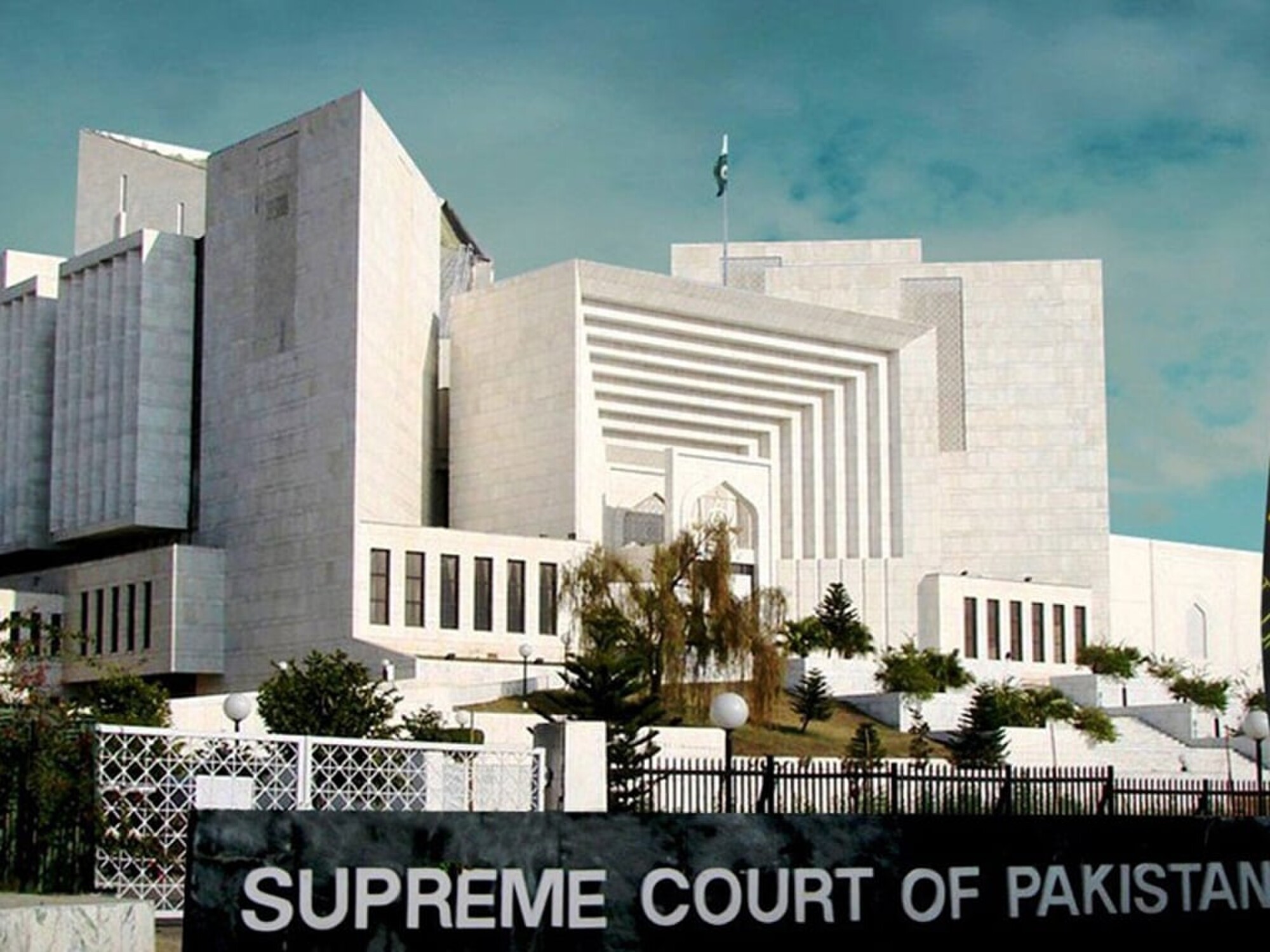
ISLAMABAD: The Supreme Court stated that the dignity of a woman, whether as a wife, sister, daughter, mother or a fellow citizen, is a fundamental value protected under the Constitution.
A two-judge bench, headed by Justice Ayesha A. Malik and comprising Justice Shahid Waheed, dismissed an appeal of a former employee of the Intelligence Bureau (IB) against the Federal Service Tribunal’s (FST) order.
Jawad Abbasi, who used to work as a cook in the IB, had filed an appeal against the verdict of the FST dated January 15. The Tribunal had upheld Abbasi’s compulsory retirement from the service.
He had faced disciplinary proceedings under the Civil Servants (Efficiency and Discipline) Rules, 2020 over allegations that he had set his wife on fire. He was also accused of being ill-mannered and short-tempered.
The departmental proceedings found the charges established, and by an order dated June 14, 2024, he was penalised with compulsory retirement. His departmental appeal in the case had also been rejected, and his appeal pertaining to his service had been dismissed by the FST. However, a lower court acquitted him in the criminal case in the matter.
The judgment, authored by Justice Waheed, stated: “The dignity of a woman, whether as a wife, sister, daughter, mother or a fellow citizen, was a fundamental value protected by the Constitution.” “Respect for that dignity is not merely a matter of personal morality; it is an obligation that the state is entitled to expect from every person in its service,” it added.
The apex court noted that the conduct of a civil servant was not judged exclusively by the manner in which he performed his official duties. His character, integrity and conduct in private life may also become relevant where these factors bore upon his suitability to hold a public office, the discipline of the service or public confidence in the institution he served, Justice Waheed emphasised.
A person’s conduct towards those within his own home may, in appropriate circumstances, reveal qualities of character that could not be disregarded merely because the conduct occurred beyond the workplace, the judgement said.
“The walls of a home are not a jurisdictional boundary, and violence does not become private because it is committed behind a closed door,” Justice Waheed stated, adding that “fire does not become a family affair because it was lit indoors”.
“The allegation is not of a quarrel or a harsh word. It is that the petitioner set his wife on fire, an act which, if established, is among the gravest forms of violence one person can inflict upon another,” the judgment said. It further stated: “It is no incident of married life; it is an assault on life and the dignity of a human being.”
The judgment noted that Article 25(3) of the Constitution permitted special provision for the protection of women, and the legislature had acted upon it through, among other enactments, the Punjab Protection of Women against Violence Act, 2016 and the Domestic Violence (Prevention and Protection) Act, 2020 for the Islamabad Capital Territory.
In addition, Pakistan was a party to the Convention on the Elimination of All Forms of Discrimination against Women under which violence against women was recognised as a form of discrimination that the state must act to eliminate, the judgement said.
“The burning of women in their homes, frequently passed off as a kitchen or stove accident or as attempted suicide, is a grave and recurring social evil in this country,” stated Justice Waheed.
Copyright Business Recorder, 2026




















Comments