


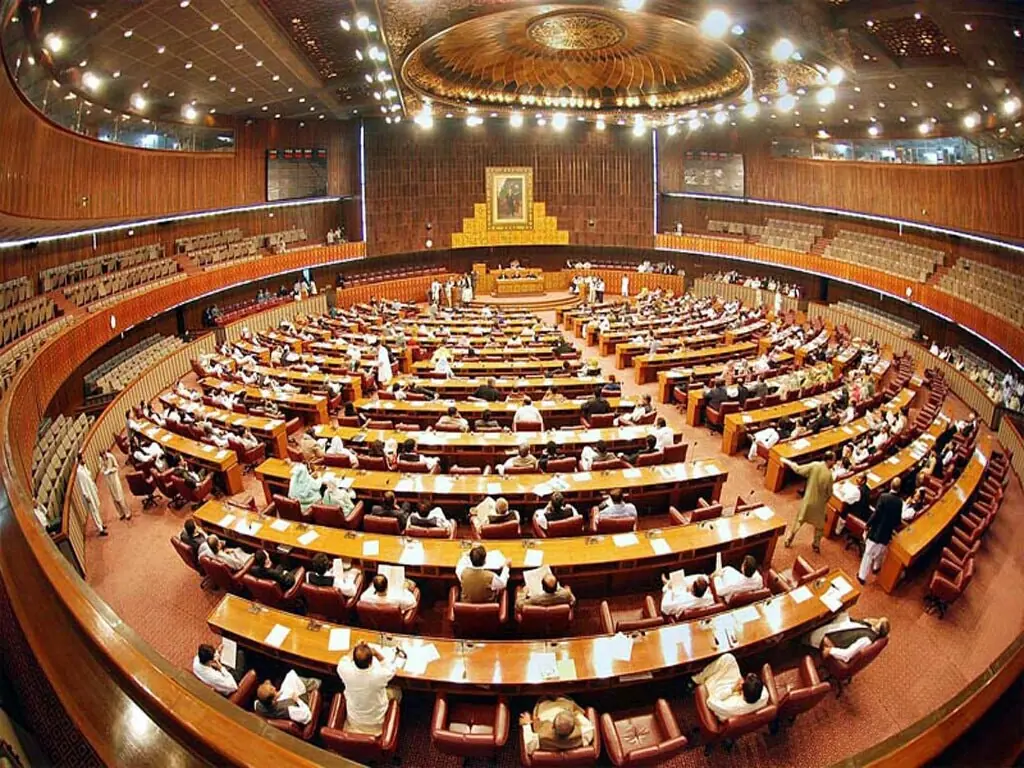
ISLAMABAD: The National Assembly on Tuesday unanimously adopted a resolution reaffirming Pakistan’s support for the right to self-determination of the people of Indian Illegally Occupied Jammu and Kashmir (IIOJK) and calling for implementation of the relevant United Nations Security Council resolutions.
The resolution, jointly moved by Minister for Kashmir Affairs and Gilgit Baltistan Amir Muqam and Chairman Parliamentary Committee on Kashmir Rana Muhammad Qasim Noon, said lasting peace and stability in South Asia depended on a just and lasting settlement of the dispute in accordance with UN resolutions and the aspirations of the Kashmiri people.
The House condemned human rights violations in IIOJK and rejected India’s unilateral actions of August 5, 2019, and subsequent measures aimed at changing the territory’s disputed status and demographic character.
It called upon India to end rights violations, release the Kashmiri leadership from incarceration and allow international human rights organisations and independent observers’ access to the region.
The resolution urged the international community, particularly the UN, to fulfil its responsibilities towards the Kashmiri people.
It also called on the government to continue diplomatic efforts at the UN, the Organisation of Islamic Cooperation and other international forums to advance their right to self-determination.
The House reiterated its moral, political and diplomatic support for the Kashmiri people.
Separately, Parliamentary Secretary for the Power Division Sardar Amir Talal Gopang told the House that 531 K-Electric feeders, around 72 per cent of the total, were exempt from load-shedding, while outages on other feeders were largely linked to distribution losses and low bill recovery.
Responding to a calling-attention notice by Syed Aminul Haq and others on unannounced power cuts and faulty feeders in Karachi, he said areas including Surjani Town, Baldia Town, Orangi Town and Lyari were affected by load-shedding because of high distribution losses and billing issues.
He said Karachi’s electricity demand was around 3,000 megawatts against regular supply of approximately 2,900MW. A temporary shortfall of 200-300MW occurred from Oct 6 to 16 due to the unavailability of liquefied natural gas cargoes, resulting in outages of up to two hours on some non-industrial feeders.
The parliamentary secretary said industrial feeders continued receiving electricity during the shortfall and offered to investigate specific complaints raised by lawmakers.
Haq accused K-Electric of operating like a “mafia”, saying the utility had earned billions through overbilling but failed to improve Karachi’s power generation, while continuing load-shedding even at night.
The Deputy Speaker Ghulam Mustafa Shah, who was presiding over the session, referred the matter to the National Assembly’s Standing Committee on Energy.
Parliamentary Secretary for Finance and Revenue Saad Wasim Sheikh defended raising the policy rate to 12pc, saying the move was necessary to curb inflation, stabilise the economy and mitigate the impact of the evolving Middle East situation.
Responding to another calling-attention notice by Naeema Kishwar, he said the monetary policy committee had approved the hike by a majority vote, warning that keeping rates unchanged would have fuelled inflation and further burdened the public.
Kishwar questioned the decision, pointing out that the government had pledged to reduce the rate to 7 percent by the following year. “How does raising the interest rate to 12 per cent provide relief to the public,” she asked.
She also cited Rs16 billion in interest payments over the past four years, criticising the burden of the interest-based financial system.
Sheikh urged lawmakers to acknowledge the government’s efforts to lower the rate from 22pc to 11pc. He added that the government aimed to make Pakistan’s economy completely interest-free by 2027-28.
Copyright Business Recorder, 2026

















Comments